Project Hail Mary (PG-13)
12/04/26 22:12 Filed in: 2026
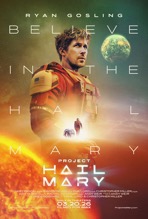
Starring: Ryan Gosling
March 2026
Warning! This is NOT a movie review. This is a critique of the film. Intended to initiate a dialogue, the following analysis explores various aspects of the film and may contain spoilers. For concerns over objectionable content, please first refer to one of the many parental movie guide websites. Ratings are based on a four star system. Happy reading!
A man awakens from an induced coma to find himself in a sleek hospital room, where fussy robotic arms tend to his every medical need. He has no idea where he is, and more importantly, who he is. Ripping himself free from myriad IVs and wires, the man climbs a ladder and opens a circular hatch door. Now he’s in a high-tech lab. He continues exploring the various rooms until he comes to a cockpit—his jaw drops when he looks through the windows and sees the inky black expanse of space.
Occasional moments of clarity break through his muddled mind; these flashbacks reveal his identity and his involvement with a top-secret project to save the Earth. The brightest scientific minds were tapped. Multi-national financing was secured. A gigantic spaceship was constructed and launched to determine what’s killing our sun and how to stop it. But why he’s on the ship, which is presently hurdling through deep space, remains a mystery. As the only surviving member of the expedition, the man quickly realizes the fate of humanity hangs on what he does next.
Based on the 2021 sci-fi novel of the same name by Andy Weir (The Martian), Project Hail Mary—an epic scale, hard science space capade—came ready-made for the big screen. Practically from the moment the book was released, there was interest in adapting it into a movie. But, to do the story justice, who in the universe could bankroll such an FX-heavy venture? In stepped Amazon MGM Studios, who put up a staggering $108 million (estimated) to bring Weir’s vision to life…a massive gamble considering the diminishing box office returns over the past few years (really, ever since COVID).
Having read the book a few years ago, I was ecstatic when I saw the trailer during the Super Bowl. Not only was it exciting to see that Weir’s brainchild was finally going to be adapted into a movie, but it also looked amazing. I hooted and hollered more at the trailer than the entire lackluster (yes, Cris Collinsworth, we get that it was a “defensive struggle”) gridiron championship.
Weir’s novel boasts the best opening of any novel I’ve ever read. As the reader, I had no idea what was going on. Due to his retrograde amnesia, neither did Ryland. As he learned things about his past, and vital clues about why he’s in space, so did I. It’s a tricky narrative device. Reveal things too quickly and you ruin the mystery and fun; reveal things too slowly and you run the risk of boring the audience. In the hands of a lesser writer, Ryland’s adventure would’ve been a colossal wreck. But, fortunately, Weir is an exceptional craftsman who delivered a masterful cross-cutting story structure that’s effective both in print and on film.
Though slight in size, the entire cast delivered exceptional performances. While Ryan Gosling as Ryland Grace (kudos to the casting director for matching the initials of the star with the story’s protagonist) wasn’t really what I envisioned of the lead character, based on descriptions of him in the book, I wasn’t averse to the casting choice. After viewing Gosling’s sometimes quirky, sometimes brilliant acting choices (especially the way he uses his eyeglasses), it’s hard to imagine anyone else in the role. Gosling, who’s no stranger to the sci-fi genre (Blade Runner 2049), imbues Ryland with just the right balance between reticence & courage, self-doubt & competence, and stoicism & emotionalism. Despite his flaws, or perhaps because of them, Ryland is an excellent representative of the human race—and Gosling’s deft portrayal of the reluctant hero is spot-on.
The cast is rounded out with some familiar faces: Ken Leung (of Lost fame) and Milana Vayntrub (of AT&T commercial fame) both play astronauts. There are also unfamiliar faces, like German actress Sandra Huller, who plays the leader of the titular project, Eva Stratt. The voice of alien Rocky, so named by Ryland, is provided by James Ortiz. In a clever cameo, we briefly hear the voice of Meryl Streep.
Project is co-directed by Phil Lord and Christopher Miller, the tandem who brought us such animated delights as Cloudy with a Chance of Meatballs (2009) and The Lego Movie (2014). Fans of the “galaxy far, far away” will also remember that the duo were in the middle of directing Solo: A Star Wars Story (2018), when, due to creative differences, they were replaced by Ron Howard. One of the reasons Lord and Miller were relieved of their directing responsibilities on Solo was that they kept veering off script (Howard intimated this in an interview). Perhaps it’s due to the author’s involvement in this project—Weir co-wrote the script with Drew Goddard—but the directors have shown the upmost reverence in hewing close to the source material.
Lord and Miller’s extensive background in animation has paid huge dividends in Project, a movie that’s largely told with sounds and visuals. Though it never quite reaches the stature of the deep space exemplar, 2001: A Space Odyssey (1968), there’s some real art here, like when Ryland meets Rocky and when Ryland takes a spacewalk.
British composer, Daniel Pemberton, has delivered a diverse and textured soundtrack for Project. One minute we’re listening to a country tune, the next a classical number, followed by a rock jam. Particularly effective are the choral sounds that the composer laces through moments of mystery and discovery, and the sprightly cues that accompany the scenes where Ryland works in the lab. Pemberton’s atmospheric, ethereal, and deeply-affecting score adds immeasurably to the film’s mood without upstaging the action.
Last general comment about the film before plunging into weightier topics: a recent trailer totally spoiled the film, right down to who Ryland is, who the alien is, what their mission is and how they’re going to save their planets. I was incensed when I saw it. Still am. I’ve railed against trailers before, but this was one of the most egregious examples I’ve ever seen. It literally disclosed everything about the story and left nothing to the imagination, except for the movie’s ending. As evidenced by my extremely restrained story synopsis at the top of this review, it is possible to tease a story without giving away all the details. Hollywood, please stop ruining movies by divulging the entire story in trailers!
As Mr. Gump famously stated, “That’s all I have to say about that.”
Spoiler Alert!
Some of the main themes in the movie focus on the need for companionship and the power of synergy. When Ryland meets and befriends Rocky, what unfolds is a kind of extra-species buddy story. The mismatched partners must rely on each other in order to survive. Awkward teamwork eventually leads to deep friendship between the pair. At different points in the story, both Ryland and Rocky are willing to sacrifice themselves for the other…absolutely inspiring!
In a heartwarming moment, Rocky calls Ryland brave. However, Ryland doesn’t see himself that way. He believes that some people are failures because they don’t rise to the challenge. He even jokes that he put the “not” in “astronaut.” Yet, when push comes to shove, Ryland always comes through. He’s the perfect definition of the everyday hero, the average person who prevails against all odds. And, since it’s so easy to sympathize with Ryland’s plight, his courageous actions are a type of wish fulfillment for the audience; after all, who wouldn’t want to be revered as the savior of the world?
A stark vision of human nature in crisis situations is posited by Eva, who projects that when the Earth starts freezing over, starving people will kill each other for food and supplies. It’s a sad commentary on the human predilection for extermination over cooperation in post-apocalyptic scenarios (look no further than dystopian movie series like Divergent and The Hunger Games and zombie TV shows like The Walking Dead for numerous examples of this). Though it might be convenient to excuse such behaviors while in the midst of life-and-death situations, the immorality of these practices should be obvious to those living in pre-apocalyptic, ostensibly civilized societies. Though barely hinted at in the film, this thorny prognostication is, as the pointed-eared guy would say, fascinating.
As in The Martian (2015), Project features a man who uses his knowledge of science to survive. Also like The Martian, nations from around the globe pool knowledge and resources to create a spaceship, which, in this case, represents the last, best hope for humanity. This kind of international cooperation is aspirational, but perhaps a bit too idealistic, especially in light of the many conflicts raging across our planet at present. You’d be hard-pressed to find a timelier message.
In the final analysis, Project is a high-stakes, high-octane thrill ride with terrific performances, stellar direction, and mind-blowing production design and visual effects.
But does the ending do justice to the movie’s strong setup?
My greatest concern with the translation from novel to script was that the ending would be botched. The book leaves things open-ended, allowing the reader to draw their own conclusion as to which fate Ryland chooses. Something about the novel’s ending reminded me of the resolution in Bradbury’s The Martian Chronicles.
As Project wound down to its final scene, I held my breath in a mixture of worry and anticipation…and then experienced a euphoric release when the story stuck the landing. The movie’s perfectly-executed coda is the ultimate grace note in one of the finest examples of sci-fi high art in cinema history.
Project completed.
Rating: 3½ out of 4