2026
Coyote vs. Acme (PG)
21/10/26 23:10

Starring: Will Forte
August 2026
Warning! This is NOT a movie review. This is a critique of the film. Intended to initiate a dialogue, the following analysis explores various aspects of the film and may contain spoilers. For concerns over objectionable content, please first refer to one of the many parental movie guide websites. Ratings are based on a four star system. Happy reading!
Coyote vs. Acme is built upon a clever premise: what if Wile E. Coyote, from the Looney Tunes cartoons, got fed up with never being able to catch Road Runner and decided to sue the Acme company since all their patented devices end up breaking down or backfiring? With other animation-infused live action flicks in the Warner Bros. filmography, such as Space Jam (1996), Looney Tunes: Back in Action (2003) and Space Jam: A New Legacy (2021), why not give this idea a whirl, right?
Unfortunately, the story, based on a New Yorker article written by Ian Frazier, starts falling flat almost immediately due to two important facts about the characters: 1. All the animated characters, consistent with the way they act in the Looney Tunes cartoons (Tweety is the one exception, but there are mitigating circumstances for the little bird’s uncharacteristic behavior) are portrayed as shallow, one-dimensional characters, and 2. The humans are all stereotypes—small-time, risk-averse lawyer who finally lands a big case, Kevin Avery (Will Forte); overeager intern, Paige Avery (Lana Condor); and bullying prosecutor, Buddy Crane (John Cena). Sidebar: is Buddy related to lawyer Denny Crane (William Shatner) in Boston Legal? Either way…shameless rip-off.
The acting here is over-the-top and relentlessly silly. It’s ironic that the animated characters are presented as real, while the human characters are depicted as caricatures.
Much of the movie centers around the titular lawsuit. As such, a significant portion of the story takes place inside a courtroom, which is, arguably, one of the most boring locations ever for a kids’ movie. Some jokes and random antics help move these scenes along, but there are long stretches of the film where characters are sitting in a courtroom with nothing major happening. There are also plenty of scenes at Kevin’s law firm; a small, dingy set, that looks similar to the law office in TVs The Rainmaker—P.J. Byrne from that show plays Bill Pelicanos, Crane’s assistant, here. These scenes aren’t lively enough for kids and aren’t compelling enough for parents…they bog down the story with mundane situations and dialog.
Then, when writers Samy Burch, James Gunn, and Jeremy Slater actually have a good idea, they squander it with gimmicks and cliches. Case in point, there’s a thrilling scene where a dark tunnel opens inside the wall of a building. Characters enter the cartoon environment, a creepy cavern that eventually reveals a clue. But, before anything interesting can happen, the characters are forced to flee the tunnel by a runaway train.
There’s so much more that could’ve been done with the animated portal that opens inside our world; like introducing an important side character, having one of the humans get lost or kidnapped, or causing the humans to stumble through a black hole, which deposits them on Mars, where they have an encounter with Marvin, who doesn’t appear in the film. Point is, the creative options were endless, yet the writers used the alternate world as a mere contrivance—the fact that the clue could’ve been revealed in numerous ways in the real world is proof positive of lazy scripting by Burch, Gunn & Slater (yep, sounds like a law firm).
One of the movie’s main themes is persistence—a quality exemplified by Coyote, who repeatedly fails and yet gets up every day and keeps trying to reach his goal. Even though Coyote’s ongoing attempts at capturing Road Runner is literally the definition of insanity, it’s an inspiring example of tenacity we humans would do well to emulate when pursuing our goals and dreams.
There’s a touching scene where Road Runner wants to know when Coyote will return to the desert. This foregrounds an unexpected friendship that’s developed between pursuer and pursued. Road Runner is the object of Coyote’s obsession (a distant echo of the eponymous white whale and Ahab in Moby-Dick) and Coyote is Road Runner’s entertainment and fitness partner.
There’s another unlikely friendship in the film. Kevin is the only person who takes Coyote seriously. He keeps fighting for the aggrieved toon despite long odds, reputational risk, and potential financial ruin. These scenes drive home another of the story’s themes—the importance of friendship—while providing some genuinely heart-warming moments.
In the end, this inoffensive family film is uber-cute and contains a few good laughs, but fails to achieve the same level of fun and synergy exhibited in Space Jam. Still, the movie’s target audience will surely enjoy the movie, regardless of my quibbles and objections.
At movie’s end, Coyote returns to the desert and his eternal pursuit of Road Runner. In our chaotic world, it’s nice to know that some things never change.
Beep, beep!
Rating: 2 out of 4
The End of Oak Street (PG-13)
18/10/26 21:38
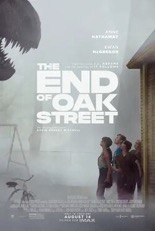
Starring: Anne Hathaway
August 2026
Warning! This is NOT a movie review. This is a critique of the film. Intended to initiate a dialogue, the following analysis explores various aspects of the film and may contain spoilers. For concerns over objectionable content, please first refer to one of the many parental movie guide websites. Ratings are based on a four star system. Happy reading!
The End of Oak Street, the new film from director David Robert Mitchell (It Follows), is an ambitious mashup of numerous franchise movies and TV series. It’s a well-balanced genre stew, combining ingredients from Jurassic Park (dinosaurs), Stranger Things (80s setting and group of boys on bikes), Under the Dome (time bubble that displaces/separates a neighborhood/town), Jumanji (large animals rampaging through suburbia), TVs Land of the Lost (a family transported to a prehistoric era), and too many other sci-fi/fantasy stories to mention here. Though the movie’s amalgamation of story elements creates a familiar formula, it’s also a winning one.
Greg Platt (Ewan McGregor) and Denise Platt (Anne Hathaway) are in a failing marriage—Greg is too laid-back and Denise is too uptight. Neither is open and honest with the other: Greg hides the fact that he’s been fired from his job and Denise is concealing a novel she writes in the basement late at night. The kids, Audrey Platt (Maisy Stella) and Brian Platt (Christian Convery) are standard issue teens with the requisite tendency toward bad decisions, which helps ratchet up the drama—the whole “kids in peril” trope.
The story, by Mitchell, wisely establishes its characters and setting before launching into the thriller elements. This allows the audience to identify with the family’s confusion and shock when they first encounter prehistoric flora and fauna. But the “terrible lizards” in the movie are more like “terrible birds.” They’re scary, but they aren’t frightening—not like the raptors or T-Rex in Jurassic Park (1993).
Unfortunately, we have the aforementioned Steven Spielberg dino-palooza to blame for the supposedly accurate version of dinosaurs (were the world’s leading dinosaur experts alive 65 million years ago to confirm the appearance of large creatures we only have skeletons of today?), which Dr. Alan Grant (RIP, Sam Neill) says resemble present-day birds more than lizards. Regardless of their veracity, the dinosaurs in this movie (e.g., raptors with plumes of feathers streaming out the back of their skull) just don’t strike fear into the viewer like Spielberg’s do.
Other than its high concept story—a family displaced in time—much of the movie is insufferably silly. In Alien (1979), Ripley (Sigourney Weaver) risks being eaten by a xenomorph to save her cat. Here, Brian runs off into the night to save his dog, Starbuck, even though he knows there are large, carnivorous creatures lurking about. Then, Audrey runs after him. I guess if the kids stayed home we’d have no story, but this is a ridiculous plot contrivance.
Side note: some have commented on how shameless it is to name the family dog after the ubiquitous coffee company. I think their opinion is erroneous. My evidence is the Battlestar Galactica (1978) poster hanging on the wall in Brian’s bedroom. Of course, maybe I’m wrong too, and the dog is named after the character in Moby-Dick.
Mitchell’s direction is taut and the action sequences are considerably gorier than those in the Jurassic films. As a horror film craftsman, Mitchell effectively utilizes offscreen sounds, rustling trees, moving shadows, and glimpses of dinosaurs to ratchet up the tension. One of the movie’s creepiest moments involves a large worm-snake, which almost seems to be smiling…until it opens its mouth and reveals rows of razor-sharp teeth. The entire sequence, where it silently slithers through the house, is peek-through-the-fingers terrifying.
Earlier, I mentioned the movie’s winning formula, which includes deft directing, solid acting, a unique take on the well-worn dino thriller form, and a rather elegant and satisfying resolution. But will this edge-of-your-seat popcorn movie do well enough to warrant a sequel? If so, I have the perfect name: A Nightmare on Oak Street.
Rating: 2 ½ out of 4
Young Washington (PG-13)
24/08/26 20:31

Starring: William Franklyn-Miller
July 2026
Warning! This is NOT a movie review. This is a critique of the film. Intended to initiate a dialogue, the following analysis explores various aspects of the film and may contain spoilers. For concerns over objectionable content, please first refer to one of the many parental movie guide websites. Ratings are based on a four star system. Happy reading!
The latest in a string of historical movies released for America’s 250th anniversary, Young Washington is exactly what you’d expect, and yet still manages to offer more.
The movie opens with the titular hero rousing from an illness as his camp is ambushed. He stumbles into the fray, yelling orders and killing enemy combatants with the requisite skill of an action hero. All of this is to be expected. But what about his coat? Red? What?
Is this an alternate history of George Washington? Nope. This is the real history we’ve forgotten or were never taught in school.
If you’re like me, and only know bits and pieces of George Washington’s (William Franklyn-Miller) Revolutionary War exploits and presidency, this new film from Angel Studios is a timely retrospective of the first U.S. president’s early years. It’s also a salient history lesson, reminding us of how dangerously close we came to never having a free country.
Young Washington is the story of an ambitious young man who wants to serve a cause bigger than himself, and to fight against tyranny. It’s also the story of an idealistic young man who, at one point, discovers he’s fighting for the wrong side. What happens then? I don’t know…we’ll have to wait for the sequel.
The movie is filled with historical dates, names and places. Even after walking out of the theater, I still wouldn’t pass a quiz on the events depicted in the movie. All I know is there were many vying armies intent on making the New World their own: the British and the French, for starters. Then there were the indigenous tribes who fought the French, fought with the French and fought each other. Then there were colonists who resisted the British invaders, and those who sympathized with them. Lots to keep track of.
The performances help ground the story’s involving historical events. For a fairly low budget, independently-produced film, Angel Studios has assembled an impressive cast of veteran actors here. Mary-Louise Parker (Weeds) plays George’s mother, Mary Washington. Kelsey Grammer (The Jesus Revolution) plays Lord Fairfax, a wealthy nobleman who takes a shine to young Washinton. Ben Kingsley (Schindler’s List) is absolutely superb as British colonial administrator, Robert Dinwiddie, Washington’s commanding officer. Rounding out the movie’s notable actors is Andy Serkis (The Lord of the Rings trilogy) who plays swaggering, pig-headed General Braddock.
Though all these actors offer solid support, it’s Franklyn-Miller who makes the movie work. He perfectly portrays Washington’s youthful exuberance, zealous idealism and strong moral convictions. Having done mostly TV work in the past, this is Franklyn-Miller’s first major role. The trajectory of his career will certainly bear close inspection.
Director Jon Erwin (I Can Only Imagine) proves himself equally adept at filming character moments and action sequences. The latter are brought to life with intricate choreography, kinetic cutting and numerous POV shots of Washington charging into battle. Though undeniably violent, the action scenes aren’t overly graphic or bloody. However, atypical for the uber-conservative features released by Angel Studios in the past, there are a handful of swear words in the film, so viewer beware.
Young Washington certainly isn’t the best historical movie ever made, but it provides a lens into the early years of our nation’s first president and the Pre-Revolutionary War period.
Will there be a sequel to this film? Perhaps entitled General Washington? To be followed by President Washington? There’s plenty of material to make several sequels to this film…that’s how extraordinary our first president was.
For what it’s worth, there’s my analysis of the movie (history teachers everywhere are shaking their heads in dismay).
So, is this film worth watching? Absolutely!
I cannot tell a lie.
Rating: 2½ out of 4
Spider-Man: Brand New Day (PG-13)
10/08/26 21:01

Starring: Tom Holland
July 2026
Warning! This is NOT a movie review. This is a critique of the film. Intended to initiate a dialogue, the following analysis explores various aspects of the film and may contain spoilers. For concerns over objectionable content, please first refer to one of the many parental movie guide websites. Ratings are based on a four star system. Happy reading!
When last we saw Peter Parker/Spider-Man (Tom Holland), he was ordering coffee in a NYC café from his girlfriend, MJ (Zendaya)—who has no idea who Peter is. To protect the ones he loves, Peter reset the universe in the previous film, Spider-Man: No Way Home (2021). Now, Peter must learn how to live without the ones he cares about most—his guardian, Aunt May (Marisa Tomei); his best friend, Ned Leeds (Jacob Batalon); and MJ.
So how does Peter respond to such a catastrophic personal loss? By throwing himself into his work. The Friendly, Neighborhood Spider-Man is back with a vengeance, ensnaring countless criminals in webs and handing vanquished villains over to the police. Well, maybe remove “Friendly” from his moniker. This new version of Spidey is far more aggressive and reckless; when he goes on a rampage, there’s collateral damage, namely destruction of property and an injured cop.
With most of Spider-Man’s rogue’s gallery behind bars, a new threat emerges and begins terrorizing the city. First, a mysterious force orchestrates an elaborate jailbreak, then an attempt is made to infiltrate a corporate building that houses a secret vault. This unseen assailant can enter a person’s thoughts and manipulate them in any way desired. As Spidey searches for a way to regulate his heightened arachnid senses, he also must track down the invisible enemy and prevent them from harming MJ, Ned and the entire city.
Spider-Man: Brand New Day is the fourth Spider-Man movie starring Tom Holland, who now becomes the most tenured actor to suit up in red spandex. Directed by Destin Daniel Cretton (Shang-Chi and the Legend of the Ten Rings), Brand New Day is a significant departure from the earlier Holland trilogy; the Harry Potter-esque easy camaraderie and teen angst that existed among the central triad is replaced with an adult story and a darker tone as Spidey goes it alone…a new day indeed.
Cretton creates a moody atmosphere with a series of superb establishing shots of NYC, often under an overcast sky. The director also takes us into gritty corners of the city previously unexplored in the earlier Holland Spider-Man movies. These are excellent creative choices as they perfectly match the somber mood and tortured psyche of the titular hero.
Though the POV shots of Spidey swinging from building to building are thrilling and immersive, the CGI isn’t much better than what you’d see in the newer Spider-Man video games. The scenes where Spider-Man holds MJ while soaring through the air are also exhilarating and recall the Superman and Lois Lane flying sequence from Superman (1978).
Brand New Day boasts a bevy of side characters, both heroes and villains (and some heroes that act like villains). Though most only have bit parts, several familiar Spider-Man villains appear in the movie, including: Ramrod (Billy Clements), Scorpion (Michael Mando) and Tombstone (Marvin Jones III). On the good side are Frank Castle/Punisher (Jon Bernthal), Dr. Bruce Banner/Hulk (Mark Ruffalo) and Yelena Belova/Black Widow (Florence Pugh).
Potty-mouthed Punisher feels out of place alongside the wholesome wallcrawler; his appearance here feels shoehorned (to raise awareness of the TV show on Disney+?). Dr. Banner and his alter ego have significant screen time, but ultimately, The Hulk is just a blunt object wielded by both the villain and the writers in the climactic action sequence. Though Black Widow provides Spidey with valuable information, her superfluous scenes (all shot in one room) could’ve been cut with little consequence.
Another new character for the good guys is NYPD Detective Jean DeWolff (Liza Colón-Zayas). Though she doesn’t know Spider-Man’s true identity, she has him on speed dial and they often consult on cases…her kids are big fans. Detective DeWolff is to Spider-Man what Commissioner Gordon is to Batman; but she doesn’t need a Bat-Signal to summon her superhero, just a cell signal.
For those who haven’t been following the news about Brand New Day, wild speculation has swirled around Sadie Sink’s unnamed role in the movie. Don’t worry, for those who haven’t already guessed, I won’t reveal the identity of the mystery character. I will say that a word linked with Sink’s character, “V-Max,” is a clever inside gag since her character’s name in Stranger Things is Max. Cutting deeper, “V-Max” is similar to “V’Ger” in Star Trek: The Motion Picture (1979) since both words contain missing letters that reveal important aspects of the plot during climactic moments of their respective movies.
When Peter begins to experience physical changes, presumably due to added stress, he desperately searches for a way to keep his arachnid DNA from triggering aggressive behaviors during heightened situations. Peter wants to rein in the negative aspects of his mutant abilities, which are causing him to commit harmful actions. He doesn’t want to do what’s wrong, but he can’t stop himself.
Peter creates several versions of an inhibitor chip to better balance his human and spider selves, and to sublimate unwanted behaviors. After much trial and error, Peter discovers the correct frequencies and creates a tiny device that he places on the back of his neck. He then wonders if it’s possible to create a universal inhibitor that can control everyone. Unfortunately, he’s late to the party on that idea, since the Mad Hatter from the Batman mythos has already mastered mind-controlling technology.
Like the Mad Hatter, this movie’s villain is all about controlling other people. The shadow character’s ability to enter a person’s mind, and then leapfrog from one person to another, is referred to as “possession,” though the powers on display are more like mental projection or telepathy. The villain can, in essence, hypnotize an individual and make that person do whatever they want; when the person snaps out of the spell, they don’t remember anything. An ethical question arises—is a person responsible for what they’ve done while under the mental control of an evil mastermind?
In one scene, the villain overrides the awareness of a random man on the street and makes him step into oncoming traffic. The mysterious antagonist kills the man, seemingly without compunction or remorse. People are just pawns to this evil mastermind. Finally, a realistic malefactor, unlike the cartoony miscreants listed above.
Though the villain instigates some of the conflicts in the movie, Spider-Man finds enough trouble on his own. Spider-Man fights a few security guards who carry machine guns and some type of electrical wand, which is similar to those brandished by General Grievous’ lackeys in Star Wars: Episode III – Revenge of the Sith (2005).
Spider-Man goes berserk in one action beat; he smashes cars (including a cop car) and pounds the daylights out of Scorpion. His aggressive behavior is similar to that of another Avenger—the Hulk. Though only in a few scenes, the not-so-jolly green giant cracks some skulls and does major damage to a building…nothing new here.
The melee where ninja-like warriors, called The Hand, attack Spidey, is the most elegantly storyboarded action sequence in the movie; it uses a variety of filming techniques including a Matrix-style slo-mo shot as Spidey bends away from throwing stars and another slo-mo shot where the warriors build a human pyramid to launch their leader at the webslinger—absolutely gorgeous cinematography. Though unquestionably violent, most of these sequences aren’t overly bloody or graphic.
While action scenes are clearly the movie’s strong suit, the plot often flounders. Largely missing from the story, written by Chris McKenna and Erik Sommers, is any hint of lightness or levity; the movie only contains a few of Spidey’s signature quips. The one major exception is the uproariously funny “stretching scene”—worth the price of admission.
Brand New Day is a jumbled web of narrative elements that the writers mistakenly think is a complete, and satisfying, Spidey tale. The story is frustratingly uneven; it’s a tug-of-war between the hero and villain, where neither comes out ahead. The movie’s Achilles’ heel is that its focus is fractured: Peter’s emotional trauma, Peter’s physical changes, Peter’s attempts at reestablishing relationships with his former friends, Punisher, Banner, Scorpion, DeWolff, the new villain, corporate corruption, other story elements, ad nauseam. What’s the movie’s overall theme? More importantly, what’s the main takeaway?
Though effective at filling in the backstory and highlighting the emotional connections between the main characters, the movie has far too many flashbacks. First, we’re in Peter’s thoughts for a montage flashback sequence. Then we’re inside the villain’s flashback. Later, the villain is inside Peter’s flashback with Peter watching from the sideline. Which character should we focus on? Whose movie is it anyway?
Despite its plot deficiencies and overblown action sequences, Brand New Day has a handful of meaningful character moments. Though far too predictable, the scenes where Peter tries to reconnect with Ned and MJ are well acted and well executed. At the end of the film, the status of Peter and MJ’s relationship is…complicated. The final scene reveals Peter’s tacit concession that befriending Ned is a far easier prospect than wooing MJ. Peter’s attempts at getting back together with MJ will surely be a major story element in the inevitable sequel.
Brand New Day certainly lives up to its name since it’s a significant departure from the earlier movies in the Holland era. It’s a tale of unrequited love, anger, revenge, and the desire to control the negative aspects of our lives. It’s also a classic example of the hero’s dichotomy: to accomplish his goal, Spider-Man must face the enemy without as well as the enemy within.
Though Brand New Day effectively moves the series forward, it’s actually more of an origin story for the villain than a towering triumph for the hero, which is disappointing. Plus, the movie is unnecessarily serious (Joker agrees).
Sad to say, but compared to many other superhero movies, Brand New Day is small potatoes.
Rating: 2½ out of 4
P.S. For those who routinely sit through the entire movie to catch an additional clip, be advised that Brand New Day contains the lamest post-credits bonus scene ever. Oh, and James Bond called and wants his sign-off back.
Pressure (PG-13)
29/07/26 21:59
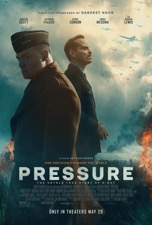
Starring: Andrew Scott
May 2026
Warning! This is NOT a movie review. This is a critique of the film. Intended to initiate a dialogue, the following analysis explores various aspects of the film and may contain spoilers. For concerns over objectionable content, please first refer to one of the many parental movie guide websites. Ratings are based on a four star system. Happy reading!
Perfectly timed to hit theaters right before the 250th Anniversary of America on July 4th, Pressure tells the story of D-Day from a unique angle most people probably haven’t considered. The movie title is a double entendre since it refers to the immense stress the leaders of the combined Allied forces were under prior to the attack, as well as the intense weather systems that created massive storms that pounded Normandy, France on the proposed date for the historic military operation. The entire thrust of the movie isn’t about what you’d expect, the preparation for the invasion or the horrific battle itself (that’s been done plenty of times before in movies). Rather, the movie is focused on the weather.
General Dwight “Ike” Eisenhower (Brendan Fraser) of the U.S. and General Bernard “Monty” Montgomery (Damian Lewis) of the U.K. are gung-ho to move forward with the unparalleled strike. But a disagreement between American meteorologist Irving Krick (Chris Messina) and British meteorologist James Stagg (Andrew Scott) throws a monkey wrench into the “go/no go” decision. Krick, who has a perfect record predicting weather for Hollywood directors and the U.S. military, calls for clear skies and sunshine. Stagg’s forecast is much gloomier: wind, rain and 8-10-foot waves. It would be impossible to conduct a full-scale naval operation in such inclement conditions.
Eisenhower and Montgomery find themselves caught between drastically divergent outlooks. As military men, their natural inclination is to attack. But, as the old chestnut cautions, discretion is the better part of valor. The arguments that ensued between these four men, and the ultimate decision they arrived at, changed the course of history.
On the face of it, an entire movie focused on the weather patterns leading up to one of our nation’s most pivotal battles doesn’t sound very exciting, but the performances help sell the story. While it’s a stretch to say Fraser looks, acts or talks like Eisenhower, he delivers a solid performance as a man desperate to atone for a recent training exercise turned bloody massacre. Lewis’ thick British accent is convincing, and his bravado and hawkish stare are highly effective in bringing Montgomery to life onscreen. Eisenhower’s assistant, Kay Summersby (Kerry Condon), is the heart and conscience of the film. She serves as a buffer between Eisenhower and Stagg, whose unwavering convictions frustrate and infuriate the action-oriented American general.
But what really makes the film pop is Messina and Scott—their backgrounds playing a cocky twit (Messina in The Newsroom) and an unhinged, evil mastermind (Scott in Sherlock), perfectly qualify them to play rockstar weatherman Krick and cautious, methodical meteorologist Stagg here. The contentious relationship between Krick and Stagg provides palpable tension, snappy dialog, and just enough doubt about who’s right to sustain the drama throughout the picture.
The friction between Krick and Stagg is, at its core, a battle of methodologies. Krick follows the time-honored approach of using weather records from the past to predict the future. Stagg believes weather is unpredictable, and can defy historic models at any moment. Stagg uses a variety of reports—measuring wind, cloud density, high altitude (via weather balloons), etc.,—from weather stations near and far (even thousands of miles away) to help him predict the weather. This weather smackdown could be billed as historical patterns v real-time data. The latter was a paradigm shift in meteorology.
When the D-Day operation is threatened by unprecedented weather (for the month of June), Krick and Stagg bury the hatchet and pool expertise to predict the best time for the Allied troops to attack the French beaches. There are some quick-cut, fairly bloodless war scenes of soldiers exiting transports and charging the beach in stormy weather. These action beats, intercut with scenes back at HQ—where worried generals wait with baited breath for the first reports to come in, are effective in giving a taste of the horrors of the conflict without delivering a blow-by-blow depiction of the battle, which you can certainly see elsewhere, i.e., Saving Private Ryan, Band of Brothers, etc. While other movies focus on the violence of the battle, Pressure focuses on how the weather affected the battle.
In the end, Pressure is a taut WWII movie that recounts the D-Day invasion from a rather solitary perspective. Whether this movie stands the test of time is anyone’s guess. But for those who love history or just want to learn something new about the landmark battle the film foregrounds, Pressure is well worth watching.
Now, if you’ll excuse me, I’m feeling the pressure to wrap this up so you can read it.
Rating: 2½ out of 4
Toy Story 5 (PG)
27/07/26 22:39
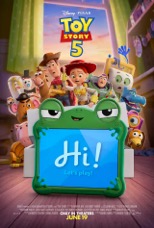
Starring: Tom Hanks
June 2026
Warning! This is NOT a movie review. This is a critique of the film. Intended to initiate a dialogue, the following analysis explores various aspects of the film and may contain spoilers. For concerns over objectionable content, please first refer to one of the many parental movie guide websites. Ratings are based on a four star system. Happy reading!
As with several prior Toy Story movies, Toy Story 5 opens with a prologue focusing on Buzz Lightyear (voiced by Tim Allen). This time, the teaser involves an army of Space Rangers in search of Star Command. The story occasionally cuts back to the brigade of Buzz’…they finally reach their objective during a pivotal scene near the end of the movie.
When the main story begins, the movie’s theme—the effects of devices on kids—is hammered home when young Bonnie (Scarlett Spears) is given a device to help her connect with other kids online. It’s a desperate decision made by loving parents who mistakenly think the device will help their lonely daughter find some new friends. Right out of the gate, the movie subtly indicts parents for allowing their kids to become addicted to screens.
The film unabashedly addresses a topic that, by now, is a universal issue, especially with kids—although many parents are addicted to video games and social media too. Some may see the movie’s message as timely, but the sad reality is kids and screens have been a problematic combination for decades (starting with Atari?).
In several scenes, adults are shown working on their computers in the same room where their kids are playing on their devices. This is another sly shot at certain parents—the “do as I say, not as I do” set. Granted, exceptions should be made for necessary internet usage, but at the end of the day, are parents any better than their kids at responsibly using personal electronic devices? Are they actually worse?
Am I being too harsh in my criticism of hypocritical (when it comes to devices) parents? Perhaps. Claiming the moral high ground on this issue is a cinch when you don’t have kids. Such status allows one to plainly see how permissive some parents are in allowing their kids to have cellphones…younger and younger all the time, it seems.
As an “outsider,” it’s easy to judge parents who allow their kids to scroll on their phone or play video games (cellphone or console) for hours on end, effectively abdicating their role as parents to devices/tech. The inconvenient truth is, for the survival of our society (yes, that sounds hyperbolic, but look at the research and trends), parents must do better where their kids and devices are concerned. Fortunately, the movie doesn’t castigate bad parents for their lax attitudes toward their children’s consumption of tech. Instead, it ends on a happy note, however disingenuous (more on this later) that conclusion is to the story.
By now, the Toy Story formula is well established—one or more characters is separated from the group and the rest of the toys must work together to rescue their lost friend. This often requires an extraordinary, coordinated effort that frequently involves a rip-roaring action sequence laced with humorous one-liners.
These movies also feature deeply-affecting moments, often dealing with the past. Tapping into emotionally-charged memories, like the tear-jerker montage when Jessie (Joan Cusack) is loved by Emily in Toy Story 2, is also a staple of these films.
But other emotions are also at play here. Jessie was left in a donation box when Emily’s family moved away. Since then, she’s dealt with abandonment issues (yes, we’re talking about toys here). Jessie has grown weary of always losing kids as they age out of playing with toys. Anger gradually turns to acceptance, which leads to the mature insight that it’s essential to enjoy every moment you have with the ones you love—a powerful message for toys and humans.
Since Jessie is sheriff now—Woody (Tom Hanks) left with Bo Peep (Annie Potts) in the previous film—and ostensibly the main character, writer/director Andrew Stanton wisely brings Jessie back to her roots…Emily’s house. The distinctive hillside with large tree and tire swing from Toy Story 2 will be a trip down memory lane for kids who grew up watching the Toy Story movies and are now adults; many of whom will have kids of their own by now. In yet another clever story element Stanton baked into the plot, this location serves as an emotional focal point for both Jessie and those who’ve seen Toy Story 2. In my master’s thesis, I dubbed this phenomenon Locus Nostalgia, which is defined as “sentimental memories for a particular place which is associated with some past event or simply an overall mood of the physical location.”
There are plenty of nuggets that can be unearthed from this “Toys v Tech” tale. First, there’s an important distinction made between playing games and playing with toys. Playing games, especially video games, engages spatial awareness, strategy and hand-eye coordination. Playing with toys promotes behavioral, social and inter-personal skills, oxytocin release from physical touch, and, crucially, learning how to use the imagination (video games blunt this ability). While there are benefits to both activities, society has skewed heavily toward playing with games, especially since the COVID lockdown period. The movie is a gentle nudge that playing with toys is an enjoyable, time-honored way for kids to have fun.
This lays the groundwork for another of the movie’s messages—tech is making kids grow up too fast. One of Bonnie’s new friends says, in a supercilious tone, she no longer plays with toys—as if doing so makes one a simpering child. Giving into peer pressure, Bonnie turns her back on Jessie and Bull’s-eye, which devastates the newly-minted sheriff and her noble steed.
Instead of playing with toys, hanging out with friends and having fun, it’s all about being part of the “in crowd” now—and the social pecking order is starting younger than ever thanks to tech. Call it Group Think 101. These days, it’s possible to be cancelled even before you graduate from elementary school. What a sad, tragic world.
The movie also touches on the issue of cyber-bullying when one of the mean girls sends a crybaby meme to represent Bonnie’s affinity for toys. Disappointingly, Bonnie’s mother just shrugs off the post as if to say, Just ignore them. Again passive/permissive parents are ruining our country by raising weak, needy, emotionally imbalanced kids, and by failing to fight for their kids in instances like this one, where clearly the bullying girl’s parents need to be confronted with what their daughter posted online. Failing to do so only reinforces bad behavior. To paraphrase the popular aphorism, evil flourishes when good people sit around and do nothing.
Having sufficiently bashed bad parents, let’s focus on the film’s true villain, the frog-themed computer tablet for kids called Lilypad (Greta Lee). Bonnie’s parents cave and buy her the popular device since all her friends have one. Bonnie becomes instantly addicted to Lily, spending hours a day playing games and conversing with her friends—selected by Lily, of course. Bonnie’s behavior and engagement with her family also radically changes…for the worse. She gets cranky when she has to wait for Lily to recharge and plays on Lily all the way up to bedtime. Bonnie becomes far more sedentary when she plays with Lily. Even worse, her vibrant personality is subdued to the point where she’s practically a zombie.
From these scenes, it’s easy to see how constant exposure to tech can negatively affect social skills and the ability to read social cues, while also numbing the pleasure centers in the brain. Many mental health issues in young people are either made by, or made worse by, the excessive use of tech. And the trend line continues to climb.
So, what makes Lily so malicious? The device chooses the wrong friends for Bonnie (something Lily admits to doing), but says it will do better in the future. Okay. So that makes up for the bullying and ostracism, right? Also, Lily thwarts Woody’s efforts to locate Jessie (the reason Lily can’t refuse Buzz’ commands is never explained—one of the movie’s only plot contrivances).
Lily’s most egregious action is hacking into Bonnie’s account and texting her father to pack up all the toys and put them in the garage. Yes, Lily helps the toys find Jessie and helps Bonnie become friends with Blaze (Mykal-Michelle Harris), but do these positive actions make up for its harmful ones? Lily never apologizes for posing as Bonnie, and manipulating Bonnie’s father, in its plot against the toys. Lily’s apparent transformation is unconvincing because we’ve seen its capacity to do evil, without hesitation or compunction, and know it’s more than capable of turning on its users in an instant. Message: beware the mercurial morality of the machine.
After an awkward introduction, Bonnie and Blaze become instant friends. That’s great for these two girls. But what about the scores of isolated kids out there? Is the happy ending, where tech decides to play nice with toys/kids/parents, disingenuous in light of the countless kids in the throes of digital obsession? Is the “tossing back one starfish at a time” approach enough to positively impact our society, or does wholesale change need to occur?
Unfortunately, the film takes the easy way out and doesn’t properly resolve its central question: What can parents do to help their kids put down their devices, go outside and make some friends? Toy Story 5 highlights a success story, but ultimately fails to deliver a plan for how parents can help their kids balance tech and real life.
Devices taking over our society—depicted in one scene as faces all around the neighborhood lit up by the green glow of electronic screens—is reminiscent of the subtle takeover of our planet by pod plants in Invasion of the Body Snatchers (1956). But is there a greater threat than tech looming on the horizon—AI? Will AI always have our best interests at heart? Doubtful. Skynet (The Terminator) could be right around the corner.
Thankfully, not all tech is portrayed as diabolical in the movie. There’s a charming subplot where older tech—devices that serve one specific function, like a pre-GPS roadmap device, or a handheld potty-training assistant for kids (which spews non-stop toilet humor)—comes to Jessie’s aid. Just as Jessie has been abandoned by Bonnie, the old devices have been relegated to junk drawers by their owners. In a twist of poetic justice, Jessie and the outmoded devices, team up to find Bonnie.
I anticipated a digital v analog showdown like the one in the reboot of Battlestar Galactica (2004), but, sadly, no such conflict occurred. It would’ve been amazing to see the older tech working together to outsmart the “smart” devices. Oh well, fodder for Toy Story 6.
Though radically different in theme and tone, this film is a kind of mirror image of Stanton’s WALL-E (2008). While the robot movie is a cautionary tale of a stark future we must work diligently to avoid, Toy Story 5 is a reprimand for the harmful societal influences that have been allowed to plague our young people. WALL-E is a deterrent; Toy Story 5 is a corrective.
Aside from its adult messages, there’s plenty to enjoy in this kids’ movie. Though merely there to service the story, the “big moment” for the Buzz army is pretty spectacular. There are some meaningful moments too—I got choked up a few times (it’s been known to happen to grown men while watching a Pixar movie), especially during the wedding scene.
So, will there be a Toy Story 6? If so, I hope it focuses more on the ancillary toys, who are largely superfluous here.
In the end, Toy Story 5 isn’t a great film, but it contains the most important message of any animated movie ever made.
Rating: 3 out of 4
Disclosure Day (PG-13)
26/07/26 22:57
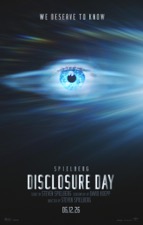
Starring: Emily Blunt
June 2026
Warning! This is NOT a movie review. This is a critique of the film. Intended to initiate a dialogue, the following analysis explores various aspects of the film and may contain spoilers. For concerns over objectionable content, please first refer to one of the many parental movie guide websites. Ratings are based on a four star system. Happy reading!
God gave us two ears and one mouth so we can listen twice as much as we speak. You’ve probably heard that aphorism. Sadly, our ability to listen to each other has been significantly impaired in recent decades, especially when the conversation turns to politics or religion.
The timeliness of director Steven Spielberg’s new thrill-fest, Disclosure Day, boarders on the preternatural. There are several hints in the movie that the world is on the brink of global upheaval. With the Russia/Ukraine, Israel/Hamas and U.S./Iran conflicts raging in real life, many believe we’re already in World War III—even if it hasn’t been officially declared as such. Coincidental parallel? Or art imitating life?
Also, the movie comes just weeks after the government declassified files/videos involving what are believed to be extraterrestrial (E.T.) phenomena. Again, is this serendipitous timing or governmental grooming, pre-conditioning people for an earth-shattering alien reveal? There’s plenty of fodder here for conspiracy enthusiasts or the average person who distrusts the powerful individuals that control our nation and the world.
Regardless of whether external agencies influenced this movie’s subject matter or release date, its premise shouldn’t be underestimated: What would you do if you saw incontrovertible proof that aliens are living among us? Would you run to your nearest superstore and hoard supplies? Would you hunker down and hope to ride it out? Would you lose your faith? Or, like Margaret Fairchild (Emily Blunt) does in the movie, would you just roll with it?
The script, written by Spielberg and David Koepp (Jurassic Park), doesn’t waste time dwelling on how humans would respond to the announcement that non-human biologics are on our planet. Instead, they distill these various reactions into a simple binary, represented by Colin Firth’s Noah Scanlon and Colman Domingo’s Hugo Wakefield. Noah wants to conceal the truth at all costs for fear of what people will do to each other. Hugo believes that people deserve to know the truth, regardless of the consequences.
Of course, this reveal/conceal dichotomy represents the diversity of arguments people in positions of power have made for decades (long before Project Blue Book) to either trust people with the truth or keep them in the dark, so as not to create a mass panic. But in the story, this complex dyad is reduced to situational ethics, hypotheticals with no real-world repercussions since Disclosure is a thriller/sci-fi movie.
The film acknowledges the corruption that pervades the halls of power around the world and how an enterprising individual can topple their house of cards by releasing the truth; whether via TV news coverage (a bit passé in the new media landscape—more on this later) in this movie, or a newspaper article in Spielberg’s The Post (2017), which this film echoes in many ways.
Governments conspiring with the military or other private science/tech firms to conceal or explain away the existence of E.T. life is nothing new (Close Encounters of the Third Kind, 1977) in cinema. But here, Spielberg reverses the conspiracy polarity from government concealment (textual—inside the world of the movie) to government propaganda (extra-textual—in the real world). To put it a different way, in past decades, audiences viewed Spielberg’s alien movies as proof of the government’s complicity in covering up the existence of E.T.s. With Disclosure, today’s savvier spectators sense they’re being manipulated, conditioned for an impending eponymous event.
The director’s conspicuous backlog of films featuring aliens, coupled with the recent declassification of some UFO—or UAP (insert vomit emoji)—files by the U.S. government, makes one wonder if this movie was produced and released as part of a government psyop? Was it all pre-arranged, priming us to accept the reality of aliens? Is Spielberg himself an alien? If so, what’s he trying to tell us?
While we’re asking questions, is Disclosure intended to trigger certain behaviors in the audience? For instance, who benefits from the universal acceptance of aliens? Or conversely, who benefits from the widespread fear of aliens? It’s obvious who profits if the movie does well at the box office.
Several scenes offer fascinating insights into the human psyche, allowing us to wrestle with the extraordinary, reality-altering revelations in the movie. During one pivotal scene, a cardinal flies through a window into Margaret’s apartment. A mental connection is made between woman and bird (an alien in disguise). Soon after the encounter, Margaret starts speaking in foreign languages without realizing it. Then, during a live weather report, she speaks in an alien dialect—a series of clicks and pops. All who hear are amazed, confused or frightened. Her boyfriend questions her sanity. She gets impressions of where certain people are located or which direction they’re traveling. Margaret’s greatest superpower is her ability to look into someone’s eyes and immediately know their deepest desires or secrets. Based on what she reads in their minds, Margaret releases people from guilt, gives helpful advice and allows people to see long-lost loved ones. Margaret’s telepathic gift is similar to Sybok’s ability to free people from their pain in Star Trek V: The Final Frontier (1989).
Another interesting subplot involves Jane Blankenship (Eve Hewson), who hides out at a Catholic nunnery to avoid Scanlon’s agents. A former novitiate who walked away from the church, Jane asks Sister Maura (Elizabeth Marvel) if she would lose her faith if it was proven E.T. life existed. The nun says no, she doesn’t believe we’re alone in the universe and that it would be a tremendous waste if God made all of it just for humans. The movie unequivocally affirms that religious people wouldn’t walk away from their faith, and, what’s more, would be even more convinced of the existence of God.
It’s unknown whether real-life religious adherents would have a similar reaction to Sister Maura’s (the events in the movie are fictional, after all), but it’s an interesting point to ponder. It’s also curious that Spielberg, a Jew, chose Catholicism to represent religion in the film; to the exclusion of all other beliefs. Regardless, it’s refreshing to see religion treated so thoughtfully and respectfully in a major Hollywood movie.
Despite its many thrilling and thoughtful moments, the story is filled with plot holes and character decisions that defy credulity. It’s ironic that the strong suit of Spielberg’s thrillers, namely action sequences, are the weak link in this film. Many of the movie’s action beats are ill-conceived, like when Daniel Kellner (Josh O’Connor) steals a car and crashes through a fence, into a tree, into other cars and into the living room of a log cabin to rescue Jane. Then he tears off with a motorcade of sleek vehicles on his tail; the car is riddled with bullets from the pursuing agents.
Later, after sending the car over a cliff to fool Scanlon’s agents, Daniel and Jane head into the woods with the men in black standing just on the other side of a boulder. Wouldn’t the agents have spotted Daniel and Jane or, at the very least, heard their movements as they traipsed through the woods? Why didn’t the deer/alien create a diversion on the other side of the road to lead the agents away from Daniel and Jane? That, at least, would’ve been more realistic.
Though Disclosure is a mashup of Close Encounters, E.T. the Extra-Terrestrial (1982), and The War of the Worlds (1953), it’s “man on the run” plot most closely resembles Minority Report (2002), a darkly futurist film that far surpasses this year’s model. The whole “diving” into other people’s minds recalls the “Pre-Cogs” from Minority Report. In this movie, characters are able to create a mind link via a gray, metallic alien device.
Spielberg and Koepp use this alien Swiss Army gadget to produce all manner of Force-like effects, but it becomes a convenient crutch for the story. Though the device doesn’t have a name, its applications are manifold—just don’t squeeze it, for heaven’s sake. The fact that its abilities, and limitations, are never clearly defined, relegates this nifty artifact to the ranks of other shameless movie gimmicks.
It’s curious that Spielberg/Koepp didn’t turn these alien devices into MacGuffins. With the powers they possess, wouldn’t everyone want one? Indeed, wouldn’t most people kill to obtain one? The magical properties inherent in these devices are completely taken for granted in the movie, which is a head-scratching nitpick.
While Spielberg deserves his fair share of criticism for the story’s shortcomings, his directing is sure-handed and, on occasion, magical. The lively TV studio scenes and the flashback sequence, where Daniel and Margaret learn vital clues about missing moments from their childhoods, is equal parts frightening and beautiful. Spielberg is no stranger to action sequences set on trains, and the one here is appropriately pulse-pounding, shot with visual verve and nail-biting near misses.
The performances in Disclosure are terrific, especially Blunt and Domingo. Firth is reliably pitch-perfect as villain Scanlon. Wyatt Russell (son of Kurt Russell), is effective as Margaret’s fair-weather boyfriend, Jackson. Marvel lives up to her name as the wise nun (Yoda/Mr. Miyagi archetype). Due to his unconvincing acting and his character’s many dunderheaded decisions, O’Connell is the weak link in the cast—ironic since he plays the main character. Despite this miss, kudos goes to Spielberg (and his casting director) for assembling a fresh slate of actors he’s never worked with before.
Someone Spielberg is extremely familiar with is composer John Williams. Disclosure marks their 30th collaboration together. Disclosure isn’t Williams’ most memorable score, but it’s one of his finest at perfectly matching the emotions of the movie. The score is beautifully understated and only grows in intensity when absolutely necessary. Interestingly, one of the main themes of this movie (heard prominently in “listen…” on the soundtrack) has strikingly similar notes, sans syncopation and fortissimo orchestration, as the “Anakin Vs. Obi-Wan” track on the Star Wars: Episode III – Revenge Of The Sith soundtrack.
Williams reportedly toiled on the score for six months and, astoundingly, composed over two hours of music for Disclosure. At age 94, will this be Williams’ final score? I sincerely hope not, but if so, the music for Disclosure highlights his virtuosity and versatility—it contains none of the bombast or rousing fanfares that marked much of his earlier work. Either way, it’s a thrill to experience another masterwork from the maestro, especially after a non-disclosed health issue sidelined him a couple years ago.
While the accompaniment certainly does its job in establishing the overall mood, what’s the real heart of the movie? Some will say the key sequence is when Daniel and Margaret use the device to learn answers about their mysterious pasts. Hard to argue, but for my money, the movie’s most meaningful moment is the subtly stated reason for why humanity is headed for destruction—the “outside observers” living among us believe we’re doomed because we’ve lost our ability to have empathy toward others.
The veracity of this profound indictment comes into sharp focus every time we watch the news. As is the case in the movie’s fictional world, there are conflicts all over the globe today. In the real world, our society is plagued with national, political, ideological, racial, ecological and religious divisions. People kill innocent bystanders on subways and have no idea why. Are we devolving into animals? Are we any less destructive than the aliens we fear?
An outside force stepping into our world and confronting us with our moral deficiencies brings to mind a similar scenario in The Day the Earth Stood Still (1951), where Klaatu (Michael Rennie) warns humanity about the dangers of nuclear power. Obviously the message impacted audiences back then since humans never initiated a nuclear war (thankfully). But Disclosure is a salient reminder of the destructive power held by nations possessing nuclear bombs, which have the capacity to end all life on our planet in a flash.
So, will our collective fear of E.T.s finally bring about global unity? Instead of fighting each other, will we pool our resources to defend Earth from alien invaders, a la the humans in the original The War of the Worlds? Or will our disunity bring about our end, as aliens sit back and watch in bewilderment as we destroy each other, a la the Twilight Zone episode, The Monsters Are Due on Maple Street?
The movie ends with an alien’s admonition for us to “Listen.” This could mean to listen to the alien, but a more likely, and poignant, reading of the scene is that “the gray” is encouraging us to listen to each other, lest our handful of wars expand to embroil the entire globe in bloody conflict. But if we can’t find a way to listen to each other, would we listen to an alien? This brings us back to The Day the Earth Stood Still, which ended well because the aliens had our best interests at heart. But what if the aliens are more like the ones in The War of the Worlds, or in TV series like V, Earth: Final Conflict or Falling Skies? Or, most frighteningly, like the Kanamits in the Twilight Zone episode, To Serve Man.
What if we end up placing our faith in aliens who aren’t trustworthy? What if they have the ability to hypnotize us or cleverly fool us into believing illusions, a la the Talosians in the Star Trek two-part episode, The Menagerie? What if the aliens win us over with lying signs and wonders, a la the Antichrist in the Bible? If someone (or something) seems to have all the answers, humanity would likely follow that individual over a cliff (e.g., Jim Jones in Jonestown, Guyana and David Koresh in Waco, Texas).
The medium for reaching the entire planet with the truth of alien existence would certainly be the internet, right? Why then does Spielberg have the titular event take place at a TV newsroom…in Kansas City of all places (I actually applaud the director for spotlighting a city other than NYC, LA or Chicago)? Yes, there’s palpable synergy in the scenes where producers yell at switchers, who direct camera operators, or when station managers call larger affiliates, who put the “small town” footage on standby. The background business of a TV news production is fascinating, especially when displayed with this degree of urgency. Spielberg has done for TV news in this film what he did for printed news in The Post.
Isn’t Spielberg a few decades behind the times, though? It’s admirable that he chose to spotlight the profession of broadcast journalism, but many people, especially those under 30, don’t watch news on a TV, and may not watch traditional news at all (online commentary shows and podcasts have significantly winnowed the TV news audience).
But let’s suspend our disbelief and say that everyone on Earth would tune into a breaking news story revealing declassified footage that definitively proved the existence of E.T.s. Would people believe it or scoff at it—just another AI fake? Just as Spielberg proves he’s out of step when it comes to the media landscape, he’s also completely unaware of how cynical his audience has become since E.T. (1982), or even Indiana Jones and the Kingdom of the Crystal Skull (2008). Many would see the alien footage, roll their eyes and play the next YouTube video. It’s a sad reflection of who we’ve become, but many would ignore the story and go on living their lives. Not to mention how fractured we’ve become along ideological lines—if the news network showing the alien vids was conservative, the liberal half of the country would tune out the “fake news,” and vice versa. Though this TV newsroom climax would’ve worked decades ago, it doesn’t work in 2026.
The most important line in the movie is when Hugo says people are starved for the truth. People, especially young people, are sick of being lied to. By politicians. By the media. By teachers, religious leaders or even parents. Within the context of the line, Hugo means people are sick of the alien coverup, but in a broader, more keenly felt way, people are starving for real truth, not fake/slanted/reverse/activist/politically-motivated/deceptive truth (otherwise known as mis-, dis-, and mal-information).
In the final analysis, Disclosure is a big swing that asks some big questions, but barely scratches the surface of how humans would react to irrefutable proof (don’t we already have that?) that aliens exist. Far greater than the middling story are the movie’s themes and messages and their implications for the future. Disclosure isn’t a great movie, but it’s insatiably thought-provoking.
The movie may be a slick example of cultivation theory or just a straightforward sci-fi yarn. Either way, viewers are sure to have strong opinions about this movie. Despite its many narrative missteps, Disclosure’s evocative subject matter elevates it to the realm of heady art at best, watercooler entertainment at worst.
So, aside from another alien movie in Spielberg’s œuvre and another hit movie on his filmography, will Disclosure make a lasting impact on its audience or society as a whole? Will the movie be a blip on the radar? Or will it goad governmental and global powers into finally revealing the truth?
Full disclosure?
I have no idea.
Rating: 3 out of 4
Star Wars: The Mandalorian and Grogu (PG-13)
20/06/26 20:47

Starring: Pedro Pascal
May 2026
Warning! This is NOT a movie review. This is a critique of the film. Intended to initiate a dialogue, the following analysis explores various aspects of the film and may contain spoilers. For concerns over objectionable content, please first refer to one of the many parental movie guide websites. Ratings are based on a four star system. Happy reading!
For several months before the release of Star Wars: The Mandalorian and Grogu, all I heard was how terrible it is. This prompts several questions about the film (aside from how so many people saw the movie before its premier). Is M&G amazing? Certainly not! Is it silly at times? Undoubtedly, especially the laughably unbelievable scene where an AT-ST walker sprints down the side of a snowy mountain. Is the movie heavy on action and thin on plot? Yep. But is it awful? No.
At 2 hours and 12 minutes, M&G plays like a glorified version of The Mandalorian TV series (2019-2023)—the uneven, episodic storytelling bolsters this notion. The action-packed opener on the Hoth-esque snow planet, the arena fight sequence, the jungle shootout and Dr. Grogu scenes and the climatic destruction of the Hutt fortress on Nal Hutta could easily be edited into 30-40-minute segments.
So, will M&G be chopped up into episodes for a possible Season 4 of the TV show? Would you put it past Disney+?
M&G is the first Star Wars movie since the final Skywalker Saga film in 2019, Star Wars: Episode IX – The Rise of Skywalker. That film had mixed reviews and fan reaction, but still made enough money to make Greedo green with envy. Will M&G be a hit, or will it continue the franchise’s trend of diminishing box office returns? TBD, but it is telling that Disney has no new Star Wars projects in production (other than Starfighter). Despite some hits, like Andor and Star Wars: Maul – Shadow Lord, most of the Star Wars TV offerings have been poor to middling, begging the question—is the franchise in decline?
Though more pedestrian than previous Star Wars movies, some of M&G’s jungle scenes are reminiscent of the slimy and grimy giant bug attack sequence in Peter Jackson’s King Kong (2005). To counterbalance the cute cuddliness of “Baby Yoda,” did writers Jon Favreau, Dave Filoni (who reprises his role as an X-wing pilot from the TV series) and Noah Kloor decide to dredge up every disgusting and vile creature they could find in the darkest corners of the “galaxy far, far away” to cater to the teenage boys in the audience? Regardless, many of these creepy scenes may be too intense for younger viewers.
A large swath of the Star Wars bestiary appears in this movie. In addition to three Hutts (Jabba’s rotund relatives), a bounty hunter (Embo) and his ravenous pet wolf, and a slew of other alien species from the earlier films and TV series, M&G features all manner of bugs, a scorpion and a giant alabaster dragon snake. Then there’s the arena on Shakari (the neon-tinged city has a decided Blade Runner vibe), where Mando (Pedro Pascal) and Rotta the Hutt (Jeremy Allen White) must fight the Dejarik (remember those holographic chess creatures in the first Star Wars movie?) menagerie in order to earn their freedom. The massive melee is another of the movie’s overlong, overblown action sequences aimed at the teen boy demo and fans of WWE or MMA matches. While I applaud the nod to the OG film, the sequence quickly becomes tedious, much like the creature clash in the arena on Geonosis in Star Wars: Episode II - Attack of the Clones (2002).
M&G’s cast is scant and, other than Mando, the most prominent characters in the movie are Grogu and Rotta—two CG characters. In fact, for a live-action movie, M&G has far more CG characters than flesh and blood ones. While the four Anzellan mechanics (remember Babu Frik from Episode IX?) will get lots of laughs, simian store owner Hugo Durant (voiced by famed film director, Martin Scorsese) steals the show.
So, what’s missing here that was in the TV series? For one thing, many of the characters we’ve grown to love are MIA: no Greef Karga because Carl Weathers has sadly passed away, no Cara Dune because Gina Carano was fired by Disney for her comments on Twitter during COVID. But where’s fellow Mandalorian, Bo-Katan Kryze (Katee Sackhoff)? And what about super villain, Moff Gideon (Giancarlo Esposito)? Or uproariously funny mechanic Peli Motto (Amy Sedaris)?
The new faces in M&G are the epitome of bit players. Garazeb “Zeb” Orrelios (Steve Blum) is on loan from the superlative animated series, Star Wars: Rebels. He’s in a few scenes, has a few lines, but has no volition or motivation apart from aiding Mando on his quest. Mando and Zeb are both pilots, so the latter’s inclusion on the mission is redundant. But I suppose Burger King needed another toy to give away with its BBQ Bounty Whopper meal (excellent, by the way), so sidekick Zeb was included in the cast.
Similarly, Colonel Ward (Sigourney Weaver) is in a handful of scenes where she critiques Mando’s “messy” missions or debriefs him on a new assignment—talky scenes that most lesser actors could’ve pulled off just fine. Ward is finally given something to do when she leads the attack against the Hutt hives on Nal Hutta during the climactic battle, but all she does is bark orders from her cockpit; an egregious underutilization of Weaver’s acting prowess.
As if the remedial dialog written for Weaver and the other performers isn’t bad enough, the cartoony plot is aimless and simplistic. The story focuses on a pair of random assignments for Mando that really don’t amount to anything. The contrived plot involving villain, Lord Janu (Jonny Coyne), is utterly daft. This supposedly devious, heartless criminal divulges key intel to the New Republic, presumably without even the threat of torture. No lies? No hedges? No erroneous information that sends the good guys on a wild goose chase? Upon further reflection, I must apologize to cartoons…many are written better than this film.
The major problem with the story is that there’s no significant character growth for Mando. He endures minor obstacles and hardships and gets by with a little help from his green friend. Grogu’s only character change is that he’s more adept at using the Force and can lift heavier objects than in the TV series. Tip for Favreau and Filoni: movies require more character growth than what Mando and company undergo here.
Still, all in not lost. The movie has a good mix of humor and action, and is well produced. Since the story is so simple, no familiarization is required to understand and enjoy the movie. Plus, M&G hits the bull’s-eye with its target demo. For better or worse, M&G has successfully introduced a new generation of fans to the franchise.
So, what does the future have in store for Mando? More TV seasons and movies? Some rumors before the movie’s release suggested that M&G would wrap up Mando’s story. It’s hard to see that being true since the movie’s resolution is so open-ended, and since die-hard fans would clamor for a better resolution.
In the end, what’s the point of the movie? There isn’t one. The sole purpose of the movie was to capitalize on the success of the TV series. But Disney’s timing is off. It’s been three years since the last episode of The Mandalorian aired. Interest in the property has waned in the intervening years to the point where this movie feels like an afterthought (or a desperate attempt at reinvigorating the TV series). Mando had his moment of glory during Seasons 1 & 2 of the TV series, but with the show in limbo and the release of this mediocre movie, it’s obvious the Force is no longer strong with Mando.
Or to put it a different way, the shine is off the beskar.
Rating: 2½ out of 4
A Great Awakening (PG-13)
19/06/26 14:52
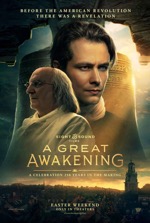
Starring: John Paul Sneed
April 2026
Warning! This is NOT a movie review. This is a critique of the film. Intended to initiate a dialogue, the following analysis explores various aspects of the film and may contain spoilers. For concerns over objectionable content, please first refer to one of the many parental movie guide websites. Ratings are based on a four star system. Happy reading!
A Great Awakening spotlights two famous men from America’s colonial period: George Whitefield (Jonathan Blair) and Benjamin Franklin (John Paul Sneed). The fiery evangelist and inventor/newspaper editor/statesman, respectively, struck up an unlikely friendship. It was a symbiotic relationship—Franklin used his printing press to help spread awareness of Whitefield and his message, and Whitefield provided sensational headlines for Franklin’s newspaper every time he traveled to Philadelphia.
Though their beliefs were completely different, both men were motivated by the pursuit of truth: Whitefield promulgated the Gospel of Truth; Franklin pursued journalistic truth. Whereas Whitefield used the spoken word to communicate with his audience, Franklin used the printed word to reach his. Both men were orators: Whitefield’s rousing words helped unify scores of Pre-Revolutionary War colonists; Franklin’s wise words helped unify quarreling delegates at the Continental Congress, the seething cauldron of viewpoints that eventually produced the Declaration of Independence.
The two men had opposite career paths—Whitefield trained to be an actor but ended up a preacher, while Franklin’s father wanted him to be a pastor, but he ended up a businessman. Also ironic is that Franklin, a deist, recommended congress should begin each day with a prayer…a practice that continues to this day.
One of the most memorable scenes in the movie is Whitefield’s first visit to the City of Brotherly Love, when he spoke to a large crowd from the courthouse balcony. Whitefield’s homily is electric and Franklin’s attempt at determining the size of the crowd (an estimated 30,000 people) is highly entertaining.
From candles to lightning rods, the movie is packed with symbols and metaphors. The film also offers some keen observations of human nature, like the brutal conditions of British coal mines of the period, and the indignance of staunch religious leaders who rejected Whitefield’s spirited, and often abrasive brand of preaching. Other insightful commentary comes from Franklin, who quips that whether soothing or stoking fears, both types of headlines sell papers.
As is often the case in life, a person’s greatest asset also can be their greatest liability. Whitefield’s ability to project his voice over large crowds eventually lead to respiratory issues—he died of asthma at age 55.
Another example of the greatest strength/greatest weakness paradox is the movie’s historical content. While it’s admirable that writers Jeff Bender, Jonathan Blair and Joshua Enck (who also directed the movie) have foregrounded the spiritual aspects of colonial America, the film’s accuracy is occasionally dubious. For instance, Whitefield’s relationship with John Wesley was far more contentious than what’s portrayed in the movie; the thorny doctrine of “predestination” significantly contributed to this rift.
Another drawback is that the accounts of Whitefield and Franklin are highly sanitized—Whitefield owned slaves and Franklin was a womanizer. Of course, this is a conservative flick, so we’re only allowed to see highly-idealized versions of these men, which diminishes the movie’s veracity and potential dramatic impact.
In the end, A Great Awakening is a well-made biopic that captures the flavor of the colonial period without fully immersing us in it. Still, it’s important for us (especially young people) to be reminded of the some of the leading figures and events of this pivotal period in our nation’s history.
The movie effectively raises awareness of how two prominent men of the past, despite different backgrounds and beliefs, forged a deep, enduring friendship. If only people of different backgrounds/beliefs/political parties could achieve the same today.
With the upcoming 250th Anniversary of our country on July 4th, the movie’s greatest success is its timing.
Rating: 2½ out of 4
Project Hail Mary (PG-13)
12/04/26 22:12
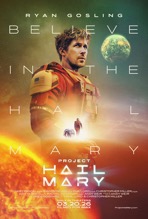
Starring: Ryan Gosling
March 2026
Warning! This is NOT a movie review. This is a critique of the film. Intended to initiate a dialogue, the following analysis explores various aspects of the film and may contain spoilers. For concerns over objectionable content, please first refer to one of the many parental movie guide websites. Ratings are based on a four star system. Happy reading!
A man awakens from an induced coma to find himself in a sleek hospital room, where fussy robotic arms tend to his every medical need. He has no idea where he is, and more importantly, who he is. Ripping himself free from myriad IVs and wires, the man climbs a ladder and opens a circular hatch door. Now he’s in a high-tech lab. He continues exploring the various rooms until he comes to a cockpit—his jaw drops when he looks through the windows and sees the inky black expanse of space.
Occasional moments of clarity break through his muddled mind; these flashbacks reveal his identity and his involvement with a top-secret project to save the Earth. The brightest scientific minds were tapped. Multi-national financing was secured. A gigantic spaceship was constructed and launched to determine what’s killing our sun and how to stop it. But why he’s on the ship, which is presently hurdling through deep space, remains a mystery. As the only surviving member of the expedition, the man quickly realizes the fate of humanity hangs on what he does next.
Based on the 2021 sci-fi novel of the same name by Andy Weir (The Martian), Project Hail Mary—an epic scale, hard science space capade—came ready-made for the big screen. Practically from the moment the book was released, there was interest in adapting it into a movie. But, to do the story justice, who in the universe could bankroll such an FX-heavy venture? In stepped Amazon MGM Studios, who put up a staggering $108 million (estimated) to bring Weir’s vision to life…a massive gamble considering the diminishing box office returns over the past few years (really, ever since COVID).
Having read the book a few years ago, I was ecstatic when I saw the trailer during the Super Bowl. Not only was it exciting to see that Weir’s brainchild was finally going to be adapted into a movie, but it also looked amazing. I hooted and hollered more at the trailer than the entire lackluster (yes, Cris Collinsworth, we get that it was a “defensive struggle”) gridiron championship.
Weir’s novel boasts the best opening of any novel I’ve ever read. As the reader, I had no idea what was going on. Due to his retrograde amnesia, neither did Ryland. As he learned things about his past, and vital clues about why he’s in space, so did I. It’s a tricky narrative device. Reveal things too quickly and you ruin the mystery and fun; reveal things too slowly and you run the risk of boring the audience. In the hands of a lesser writer, Ryland’s adventure would’ve been a colossal wreck. But, fortunately, Weir is an exceptional craftsman who delivered a masterful cross-cutting story structure that’s effective both in print and on film.
Though slight in size, the entire cast delivered exceptional performances. While Ryan Gosling as Ryland Grace (kudos to the casting director for matching the initials of the star with the story’s protagonist) wasn’t really what I envisioned of the lead character, based on descriptions of him in the book, I wasn’t averse to the casting choice. After viewing Gosling’s sometimes quirky, sometimes brilliant acting choices (especially the way he uses his eyeglasses), it’s hard to imagine anyone else in the role. Gosling, who’s no stranger to the sci-fi genre (Blade Runner 2049), imbues Ryland with just the right balance between reticence & courage, self-doubt & competence, and stoicism & emotionalism. Despite his flaws, or perhaps because of them, Ryland is an excellent representative of the human race—and Gosling’s deft portrayal of the reluctant hero is spot-on.
The cast is rounded out with some familiar faces: Ken Leung (of Lost fame) and Milana Vayntrub (of AT&T commercial fame) both play astronauts. There are also unfamiliar faces, like German actress Sandra Huller, who plays the leader of the titular project, Eva Stratt. The voice of alien Rocky, so named by Ryland, is provided by James Ortiz. In a clever cameo, we briefly hear the voice of Meryl Streep.
Project is co-directed by Phil Lord and Christopher Miller, the tandem who brought us such animated delights as Cloudy with a Chance of Meatballs (2009) and The Lego Movie (2014). Fans of the “galaxy far, far away” will also remember that the duo were in the middle of directing Solo: A Star Wars Story (2018), when, due to creative differences, they were replaced by Ron Howard. One of the reasons Lord and Miller were relieved of their directing responsibilities on Solo was that they kept veering off script (Howard intimated this in an interview). Perhaps it’s due to the author’s involvement in this project—Weir co-wrote the script with Drew Goddard—but the directors have shown the upmost reverence in hewing close to the source material.
Lord and Miller’s extensive background in animation has paid huge dividends in Project, a movie that’s largely told with sounds and visuals. Though it never quite reaches the stature of the deep space exemplar, 2001: A Space Odyssey (1968), there’s some real art here, like when Ryland meets Rocky and when Ryland takes a spacewalk.
British composer, Daniel Pemberton, has delivered a diverse and textured soundtrack for Project. One minute we’re listening to a country tune, the next a classical number, followed by a rock jam. Particularly effective are the choral sounds that the composer laces through moments of mystery and discovery, and the sprightly cues that accompany the scenes where Ryland works in the lab. Pemberton’s atmospheric, ethereal, and deeply-affecting score adds immeasurably to the film’s mood without upstaging the action.
Last general comment about the film before plunging into weightier topics: a recent trailer totally spoiled the film, right down to who Ryland is, who the alien is, what their mission is and how they’re going to save their planets. I was incensed when I saw it. Still am. I’ve railed against trailers before, but this was one of the most egregious examples I’ve ever seen. It literally disclosed everything about the story and left nothing to the imagination, except for the movie’s ending. As evidenced by my extremely restrained story synopsis at the top of this review, it is possible to tease a story without giving away all the details. Hollywood, please stop ruining movies by divulging the entire story in trailers!
As Mr. Gump famously stated, “That’s all I have to say about that.”
Spoiler Alert!
Some of the main themes in the movie focus on the need for companionship and the power of synergy. When Ryland meets and befriends Rocky, what unfolds is a kind of extra-species buddy story. The mismatched partners must rely on each other in order to survive. Awkward teamwork eventually leads to deep friendship between the pair. At different points in the story, both Ryland and Rocky are willing to sacrifice themselves for the other…absolutely inspiring!
In a heartwarming moment, Rocky calls Ryland brave. However, Ryland doesn’t see himself that way. He believes that some people are failures because they don’t rise to the challenge. He even jokes that he put the “not” in “astronaut.” Yet, when push comes to shove, Ryland always comes through. He’s the perfect definition of the everyday hero, the average person who prevails against all odds. And, since it’s so easy to sympathize with Ryland’s plight, his courageous actions are a type of wish fulfillment for the audience; after all, who wouldn’t want to be revered as the savior of the world?
A stark vision of human nature in crisis situations is posited by Eva, who projects that when the Earth starts freezing over, starving people will kill each other for food and supplies. It’s a sad commentary on the human predilection for extermination over cooperation in post-apocalyptic scenarios (look no further than dystopian movie series like Divergent and The Hunger Games and zombie TV shows like The Walking Dead for numerous examples of this). Though it might be convenient to excuse such behaviors while in the midst of life-and-death situations, the immorality of these practices should be obvious to those living in pre-apocalyptic, ostensibly civilized societies. Though barely hinted at in the film, this thorny prognostication is, as the pointed-eared guy would say, fascinating.
As in The Martian (2015), Project features a man who uses his knowledge of science to survive. Also like The Martian, nations from around the globe pool knowledge and resources to create a spaceship, which, in this case, represents the last, best hope for humanity. This kind of international cooperation is aspirational, but perhaps a bit too idealistic, especially in light of the many conflicts raging across our planet at present. You’d be hard-pressed to find a timelier message.
In the final analysis, Project is a high-stakes, high-octane thrill ride with terrific performances, stellar direction, and mind-blowing production design and visual effects.
But does the ending do justice to the movie’s strong setup?
My greatest concern with the translation from novel to script was that the ending would be botched. The book leaves things open-ended, allowing the reader to draw their own conclusion as to which fate Ryland chooses. Something about the novel’s ending reminded me of the resolution in Bradbury’s The Martian Chronicles.
As Project wound down to its final scene, I held my breath in a mixture of worry and anticipation…and then experienced a euphoric release when the story stuck the landing. The movie’s perfectly-executed coda is the ultimate grace note in one of the finest examples of sci-fi high art in cinema history.
Project completed.
Rating: 3½ out of 4
I Can Only Imagine 2 (PG)
03/04/26 22:42

Starring: John Michael Finley
February 2026
Warning! This is NOT a movie review. This is a critique of the film. Intended to initiate a dialogue, the following analysis explores various aspects of the film and may contain spoilers. For concerns over objectionable content, please first refer to one of the many parental movie guide websites. Ratings are based on a four star system. Happy reading!
I must admit, I was skeptical when I first learned there would be a sequel to I Can Only Imagine (2018). First, how could directors Andrew Erwin and Brent Mccorkle improve on the original movie—easily one of the Top 5 Christian movies ever made? Second, with Bart Millard’s (John Michael Finley) back story and initiation into stardom established in the first film, how could a sequel about a band going on tour after winning a trophy case full of awards for the titular song sustain audience interest for two hours? Or, maybe I was just fretful that the sequel wouldn’t live up to the original, a rational apprehension considering Hollywood’s track record.
I’m glad I was wrong about Imagine 2. It’s one of those rare instances where the sequel is a worthy follow-up to the original.
Early in the film, Bart receives a frantic call from his wife while he’s on the road. Rushing to the hospital, Bart learns that his young son, Sam (Jagger Amor), has diabetes and will need to take insulin shots the rest of his life. At first, Bart, who was physically abused by his father, Arthur (Dennis Quaid), can’t bring himself to stick a shot into Sam’s stomach. But when he sees another couple lose their son with the same condition as Sam’s, Bart quickly gets over his reticence of jabbing his son with life-sustaining medicine.
A decade later, Sam (Sammy Dell) is a teenage boy, who, like most teenage boys, is wrapped up in his own world—and consistently forgets to take his medication. This creates resentment between Bart, who’s trying to be a loving but firm parent, and Sam, who wants the freedom to pursue his dream of being a musician. Bart tells his wife he’s the wrong father for Sam; his feelings of inadequacy stem from a deep-rooted fear that he’ll become like his father.
Scott Brickell (Trace Adkins), the manager of Bart’s group, MercyMe, has a wild idea—bring Sam on the road for the upcoming tour. Though the radical decision creates plenty of drama and a near-tragic moment, it allows Bart and Sam to connect in new and unexpected ways.
Also joining the tour as the concert opener is Tim Timmons (Milo Ventimiglia), who fills the role of “new guy” in the group (a long-standing war movie trope). The band’s initiation of the newcomer, when Tim uses the bathroom on the bus, is uproariously funny.
Initially, there’s competitive friction between Bart and Tim, which serves as a protagonist/antagonist dynamic in a movie without a true villain. But Bart’s attitude toward Tim radically changes when Tim reveals he has a rare illness. Tim, who just wants to reach people with his songs, asks Bart to complete a lyric he’s stuck on. When finished, Bart and Tim’s song, “Even If,” becomes one of MercyMe’s biggest hits.
As the band’s outsiders, Tim and Sam quickly develop a rapport. The unlikely pair are kindred spirits—they both play guitar, they both love music, and they both have serious health conditions. Early in the tour, Tim asks Sam to play guitar for his opening set, which brings Sam one step closer to his dream.
One of the movie’s main themes is grief vs. gratitude. Tim makes an X (also the symbol for the cross) with a Sharpie on his wrist every morning as a reminder of his gratitude for another day of life. It’s a beautiful symbol that recurs throughout the movie. Tim is fixated on the tragic story of Horatio G. Spafford, who wrote the traditional hymn, “It Is Well with My Soul.” It’s a message Bart needs to be reminded of as he’s still haunted by his traumatic childhood.
In a heartwarming flashback, Bart helps Arthur move some chairs found along the roadside out of his father’s pickup truck. Later that night, while sitting in the “new” chairs around a campfire, Arthur tells Bart he’s proud of him. This is the first of two father/son reconciliation scenes.
There’s another campfire scene under a bridge after the tour bus breaks down. During the light-hearted conversation, Sam reveals what he fears most in life—needles. It’s a sobering reminder of the teen’s daily battle for his health.
Setup: in a meaningful father/son scene in a café, where Bart and Sam play a game of 20 Questions, Bart learns that Sam has never seen a shooting star.
Payoff: in a later scene, as father and son spend some quality time on top of the broken-down bus, a shooting star streams across the expansive night sky.
There are many such emotional high points in the movie, like when Bart gives his son Arthur’s guitar, when Sam fills in for an ailing Tim during sound check and crushes it, or when Bart visits Tim in the hospital as a thunderstorm rages in the distance—symbolic of the internal storms both men are facing.
Fittingly, the movie’s climax is the final concert of MercyMe’s tour at the Red Rocks amphitheater in Colorado. Bart calls an audible and concludes the concert with “Even If.” He asks Sam to accompany them on guitar. After the song, Bart hugs Sam on stage; it’s a touching culmination of the father/son storyline.
Unfortunately, what should’ve been a satisfying ending is ruined by the final scene of the movie; Bart and his wife sneak onto the bus, presumably to do what married couples do. It’s a strange ending to an otherwise moving and inspirational movie.
So, in a few years, when Sam has a child who becomes a professional singer, I guess we can look forward to I Can Only Imagine 3.
Rating: 3 out of 4
Solo Mio (PG)
01/04/26 21:57
Starring: Kevin James
February 2026
Warning! This is NOT a movie review. This is a critique of the film. Intended to initiate a dialogue, the following analysis explores various aspects of the film and may contain spoilers. For concerns over objectionable content, please first refer to one of the many parental movie guide websites. Ratings are based on a four star system. Happy reading!
Man is left at the altar.
Man meets a new group of friends who help him grieve and heal.
Man finds a new woman.
Man falls in love with the woman and lives happily ever after.
Okay, so the storyline to Angel Studio’s new movie, Solo Mio, isn’t quite that simplistic. And yet, there isn’t anything revolutionary about this standard romance movie either.
Kevin James (The King of Queens) plays Matthew Taylor, a likeable 50-something art teacher who proposes to Heather (Julie Ann Emery). She says yes, and now the couple is in Rome for their wedding and honeymoon. Then comes Heather’s no-show at the wedding and Matthew’s discovery of the note she leaves for him.
With a stiff upper lip, Matthew tries to recover from his heartache by embarking on day trips for honeymooning couples; they’re pre-paid and non-refundable, so why not take advantage of them? Overcoming the embarrassment of riding by himself on a tandem bike, Mike is befriended by two couples: Jules (Kim Coates) and Meghan (Alyson Hannigan), and Neil (Jonathan Roumie) and Donna (Julee Cerda). These couples attempt to console Matthew during his period of grief, often providing comic relief when their well-meaning advice ends up creating more drama and ridiculous situations.
Just days after being jilted by his fiancée, Matthew meets café manager Gia (Nicole Grimaudo); Jules and Neil encourage him to explore the potential new relationship. You’d think Donna, a professional therapist, would be a voice of reason and at least recommend that Matthew take things slow during the recovery process. Nope. The movie doesn’t engage in that kind of common sense…or common decency.
Aside from a minor twist involving the note Heather leaves in the church before she bails, the rest of the plot is paint-by-numbers predictable.
Directed by Charles Kinnane and Daniel Kinnane, Solo Mio is a disappointment for several reasons. With well-known comedians like James and Hannigan in the cast, you’d expect the movie to be funnier than it is. Though Coates and Roumie (Jesus in The Chosen) deliver a few humorous lines, this film doesn’t even remotely resemble the riotous romcom presented in the trailer.
Up until now, Angel Studios has produced faith-affirming and family-friendly films. Solo Mio, with its pervasive alcohol consumption, a promiscuous woman at a nightclub, Matthew dancing with his imaginary fiancée in his underwear, and handful of profanities, is quite a departure from the squeaky-clean fare typically associated with the studio. Viewer beware.
Though contrived to the point of absurdity, the cameo by Andrea Bocelli (who sings a few songs in the movie) is a decided boon to the story. After all, what’s more quintessentially Italian than Bocelli?
But this stunt casting reveals the movie’s Achilles’ heel. Aside from its schmaltzy subplots (pretty much every scene involving the bike tour); the unbelievable, instant romance between Matthew and Gia; and the gimmicky twist involving the composition of the breakup note, the worst aspect of the movie is the way every problem is resolved with crowd-pleasing convenience. Writers Patrick Kinnane, John Kinnane and James have delivered a bevy of romance film tropes, but haven’t posited a single new thought or forwarded the genre in any significant way. The film resolves much too quickly and the new equilibrium for the characters at the end is an egregious farce—Matthew will leave his job and his country to live with a woman he just met?
But all is not lost. James delivers a believable performance and the supporting cast is solid. The movie’s saving grace is its foreign locations; the villas and vistas shot in and around Rome. But without its foreign flair, would the movie even be half as good as it is? Or half as memorable?
In the end, this movie isn’t nearly as funny or romantic as it should’ve been. Much like the woman who leaves poor Matthew at the altar, Solo Mio is an underachieving mess.
Rating: 2 out of 4