Exodus: Gods and Kings (PG-13)
18/12/14 23:00 Filed in: 2014
Starring: Christian Bale
December 2014
This review was originally tweeted in Real-time from the back row of a movie theater and appears @BackRoweReviews. Though efforts were made to tease rather than ruin this movie’s memorable lines and moments, some spoilers may exist in the following evaluation. The original tweets appear in black, while follow-up comments appear in red. For concerns over objectionable content, please first refer to one of the many parental movie guide websites. All ratings are based on a four star system. Happy reading!

Reading entrails. Eww. How barbaric.
Kind of a gross scene to start a Biblical epic with, yes? But at least an alien didn’t burst out of the dead bird’s chest!
A clash of swords...a sign of things to come.
The next time their swords clash, Moses will be banished from the kingdom.
The rain of arrows is spectacular. The rest of the battle isn’t bad either.
The confrontation definitely has a LOTR aesthetic and pace to it, but it isn’t nearly as protracted or flashy as the melees in Peter Jackson’s Middle Earth films.
Moses visits the viceroy...insists on looking the slaves in the eye.
Moses spares Breaking Bad’s #AaronPaul from the whip.
Turns out that Paul’s character is named Joshua, the man who eventually succeeds Moses.
Moses learns about his true identity from #SirBenKingsley.
If Kingsley told me my dad was a hippo and my mother was a rhino I’d probably believe him. The man has gravitas.
Moses looses one horse but gets two more.
It’s almost as if someone up there is looking out for him. Of course, Moses had to slay two assassins in order to acquire the steeds. The Lord giveth and the Lord taketh away, I suppose.
Moses answers the three questions correctly and gets to “proceed.”
Most men would die to have such an easy path to pleasure. Just my luck, but whenever I try playing that game it always ends up being twenty questions.
The burning bush sequence is very different, but very effective.
If there’s any scene in the movie that will spark controversy, this is it. Moses’ mud bath and chat with a young boy is way out in left field compared to a traditional interpretation of the burning bush event in the Bible.
Moses returns to Memphis...not the one in Tennessee.
The locals say it’s nice this time of year, but maybe they’re just in d’Nile. Yuk, yuk.
Ramesses watches his boats set ablaze by flaming arrows. A brilliant visual.
These minor acts of rebellion are but pinpricks to the mighty Pharaoh. However, where human agency ends, God’s might begins. Prepare for the twelve plagues.
Hmm...I never knew that crocodiles initiated the plagues.
However, this feeding frenzy is a spectacular feat of CG wizardry…and is also pretty gruesome.
Darkness falls over the city like an ashen shroud. Then the cries of terror ascend. Spine-tingling!
Ironically, this “angel of death” visual is far less elaborate, from an FX standpoint, than the ones in many of the earlier Moses films. Though low-tech and fairly simple to achieve, this sequence is highly effective.
The chariot pileup is awesome.
You just knew Ramesses’ hubris would lead to this end. But it’s still a spectacular cataclysm.
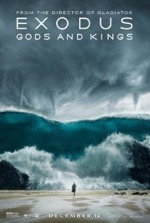
Tornadoes and tsunamis...oh my!
I couldn’t think of a third “T” word, but you get the point.
“They’re my people.” Goosebumps.
Actually, they’re God’s people but since it’s such a great line, and because the actor moonlights as Batman, we’ll let it slide.
Final analysis: a reverent treatment of the Biblical account with minor deviations from the text.
3 out of 4. Though more epic in scale, it still lacks the heart, and faith, of DeMille’s version.
Though not as blatantly sacrilegious as Darren Aronofsky’s Noah (2014), Ridley Scott’s rendition of the exodus saga takes occasional liberties with the sacred text which will, undoubtedly, create a great deal of controversy among theological fundamentalists. There doesn’t seem to be a happy medium with these big screen Bible features—they’re either poorly produced but theologically accurate or lavishly produced but brimming with questionable creative departures or outright heretical story elements. In Exodus, you can tell that Scott’s intentions were to evince the appropriate degree of reverence toward the source material while making art with some selected story elements. Unfortunately, the results are a mixed bag. The major action sequences look like they were storyboarded by Peter Jackson or Steven Spielberg, which is to say they look amazing but are better suited to a blockbuster adventure film than a historical epic. Some of the movie’s major narrative turning points are radically different from what appears in the Bible; chief among them is the head-scratching burning bush episode. Still, the plagues play out pretty much as you’d expect them to (except for the croc crock) and the “death angel” scene stands out as a prime example of how, when it comes to FX, sometimes less is more. Just like in Noah (see my review) however, the divine is often explained away by human reasoning here: the “scientific” explanation of the plagues, the receding of the sea (with the addition of tornadoes just because they look really cool), etc. The characterization of Moses has also been altered for wider appeal since listening to Bale stutter his way through two and a half hours of dialog would’ve been a major detractor to the story’s enjoyment. Bale’s Moses is decisive, confident and heroic: the real Moses struggled to exhibit any of the above attributes and, as a result, had to rely upon God for his strength…which is a major point of emphasis throughout his character arc. As flawed as the patriarch’s portrayal is, Scott’s depiction of the Almighty is downright disturbing. Scott consistently paints God as an angry tyrant. Worse still, this God is revealed as a warmonger when He expresses how pathetically ineffective Moses’ acts of sedition have been and how more aggressive, i.e., supernatural, measures are required in order to bring the evil Pharaoh to his knees. Is this really Scott’s perception of God? If so, it certainly explains the movie’s authoritarian portrait of the Big Guy (Boy?) Upstairs. The forging of the Ten Commandments was a visual extravaganza in Cecil B. DeMille’s 1956 masterpiece, but, for whatever reason, Scott chose to eschew FX during this dramatic passage—the low key scene sees Moses chiseling the tablets himself while the mental apparition of God stands around and bickers with him. Judging by this scene, it would appear that Scott’s God is also a micromanaging taskmaster (or is just plain lazy). In the end, this film will go down as an entertaining examination of this exilic event, but it certainly won’t be esteemed as a faithful adaptation of the Biblical account. However, Exodus is an updated cinematic spectacle with modern visual effects and big name stars, so it serves its purpose as a sensational, yet superficial, survey of this standout Sunday school story.