July 2026
Pressure (PG-13)
29/07/26 21:59 Filed in: 2026
Starring: Andrew Scott
May 2026
Warning! This is NOT a movie review. This is a critique of the film. Intended to initiate a dialogue, the following analysis explores various aspects of the film and may contain spoilers. For concerns over objectionable content, please first refer to one of the many parental movie guide websites. Ratings are based on a four star system. Happy reading!
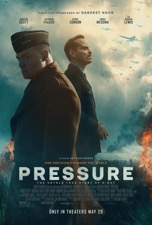
Perfectly timed to hit theaters right before the 250th Anniversary of America on July 4th, Pressure tells the story of D-Day from a unique angle most people probably haven’t considered. The movie title is a double entendre since it refers to the immense stress the leaders of the combined Allied forces were under prior to the attack, as well as the intense weather systems that created massive storms that pounded Normandy, France on the proposed date for the historic military operation. The entire thrust of the movie isn’t about what you’d expect, the preparation for the invasion or the horrific battle itself (that’s been done plenty of times before in movies). Rather, the movie is focused on the weather.
General Dwight “Ike” Eisenhower (Brendan Fraser) of the U.S. and General Bernard “Monty” Montgomery (Damian Lewis) of the U.K. are gung-ho to move forward with the unparalleled strike. But a disagreement between American meteorologist Irving Krick (Chris Messina) and British meteorologist James Stagg (Andrew Scott) throws a monkey wrench into the “go/no go” decision. Krick, who has a perfect record predicting weather for Hollywood directors and the U.S. military, calls for clear skies and sunshine. Stagg’s forecast is much gloomier: wind, rain and 8-10-foot waves. It would be impossible to conduct a full-scale naval operation in such inclement conditions.
Eisenhower and Montgomery find themselves caught between drastically divergent outlooks. As military men, their natural inclination is to attack. But, as the old chestnut cautions, discretion is the better part of valor. The arguments that ensued between these four men, and the ultimate decision they arrived at, changed the course of history.
On the face of it, an entire movie focused on the weather patterns leading up to one of our nation’s most pivotal battles doesn’t sound very exciting, but the performances help sell the story. While it’s a stretch to say Fraser looks, acts or talks like Eisenhower, he delivers a solid performance as a man desperate to atone for a recent training exercise turned bloody massacre. Lewis’ thick British accent is convincing, and his bravado and hawkish stare are highly effective in bringing Montgomery to life onscreen. Eisenhower’s assistant, Kay Summersby (Kerry Condon), is the heart and conscience of the film. She serves as a buffer between Eisenhower and Stagg, whose unwavering convictions frustrate and infuriate the action-oriented American general.
But what really makes the film pop is Messina and Scott—their backgrounds playing a cocky twit (Messina in The Newsroom) and an unhinged, evil mastermind (Scott in Sherlock), perfectly qualify them to play rockstar weatherman Krick and cautious, methodical meteorologist Stagg here. The contentious relationship between Krick and Stagg provides palpable tension, snappy dialog, and just enough doubt about who’s right to sustain the drama throughout the picture.
The friction between Krick and Stagg is, at its core, a battle of methodologies. Krick follows the time-honored approach of using weather records from the past to predict the future. Stagg believes weather is unpredictable, and can defy historic models at any moment. Stagg uses a variety of reports—measuring wind, cloud density, high altitude (via weather balloons), etc.,—from weather stations near and far (even thousands of miles away) to help him predict the weather. This weather smackdown could be billed as historical patterns v real-time data. The latter was a paradigm shift in meteorology.
When the D-Day operation is threatened by unprecedented weather (for the month of June), Krick and Stagg bury the hatchet and pool expertise to predict the best time for the Allied troops to attack the French beaches. There are some quick-cut, fairly bloodless war scenes of soldiers exiting transports and charging the beach in stormy weather. These action beats, intercut with scenes back at HQ—where worried generals wait with baited breath for the first reports to come in, are effective in giving a taste of the horrors of the conflict without delivering a blow-by-blow depiction of the battle, which you can certainly see elsewhere, i.e., Saving Private Ryan, Band of Brothers, etc. While other movies focus on the violence of the battle, Pressure focuses on how the weather affected the battle.
In the end, Pressure is a taut WWII movie that recounts the D-Day invasion from a rather solitary perspective. Whether this movie stands the test of time is anyone’s guess. But for those who love history or just want to learn something new about the landmark battle the film foregrounds, Pressure is well worth watching.
Now, if you’ll excuse me, I’m feeling the pressure to wrap this up so you can read it.
Rating: 2½ out of 4
Toy Story 5 (PG)
27/07/26 22:39 Filed in: 2026
Starring: Tom Hanks
June 2026
Warning! This is NOT a movie review. This is a critique of the film. Intended to initiate a dialogue, the following analysis explores various aspects of the film and may contain spoilers. For concerns over objectionable content, please first refer to one of the many parental movie guide websites. Ratings are based on a four star system. Happy reading!
As with several prior Toy Story movies, Toy Story 5 opens with a prologue focusing on Buzz Lightyear (voiced by Tim Allen). This time, the teaser involves an army of Space Rangers in search of Star Command. The story occasionally cuts back to the brigade of Buzz’…they finally reach their objective during a pivotal scene near the end of the movie.
When the main story begins, the movie’s theme—the effects of devices on kids—is hammered home when young Bonnie (Scarlett Spears) is given a device to help her connect with other kids online. It’s a desperate decision made by loving parents who mistakenly think the device will help their lonely daughter find some new friends. Right out of the gate, the movie subtly indicts parents for allowing their kids to become addicted to screens.
The film unabashedly addresses a topic that, by now, is a universal issue, especially with kids—although many parents are addicted to video games and social media too. Some may see the movie’s message as timely, but the sad reality is kids and screens have been a problematic combination for decades (starting with Atari?).
In several scenes, adults are shown working on their computers in the same room where their kids are playing on their devices. This is another sly shot at certain parents—the “do as I say, not as I do” set. Granted, exceptions should be made for necessary internet usage, but at the end of the day, are parents any better than their kids at responsibly using personal electronic devices? Are they actually worse?
Am I being too harsh in my criticism of hypocritical (when it comes to devices) parents? Perhaps. Claiming the moral high ground on this issue is a cinch when you don’t have kids. Such status allows one to plainly see how permissive some parents are in allowing their kids to have cellphones…younger and younger all the time, it seems.
As an “outsider,” it’s easy to judge parents who allow their kids to scroll on their phone or play video games (cellphone or console) for hours on end, effectively abdicating their role as parents to devices/tech. The inconvenient truth is, for the survival of our society (yes, that sounds hyperbolic, but look at the research and trends), parents must do better where their kids and devices are concerned. Fortunately, the movie doesn’t castigate bad parents for their lax attitudes toward their children’s consumption of tech. Instead, it ends on a happy note, however disingenuous (more on this later) that conclusion is to the story.
By now, the Toy Story formula is well established—one or more characters is separated from the group and the rest of the toys must work together to rescue their lost friend. This often requires an extraordinary, coordinated effort that frequently involves a rip-roaring action sequence laced with humorous one-liners.
These movies also feature deeply-affecting moments, often dealing with the past. Tapping into emotionally-charged memories, like the tear-jerker montage when Jessie (Joan Cusack) is loved by Emily in Toy Story 2, is also a staple of these films.
But other emotions are also at play here. Jessie was left in a donation box when Emily’s family moved away. Since then, she’s dealt with abandonment issues (yes, we’re talking about toys here). Jessie has grown weary of always losing kids as they age out of playing with toys. Anger gradually turns to acceptance, which leads to the mature insight that it’s essential to enjoy every moment you have with the ones you love—a powerful message for toys and humans.
Since Jessie is sheriff now—Woody (Tom Hanks) left with Bo Peep (Annie Potts) in the previous film—and ostensibly the main character, writer/director Andrew Stanton wisely brings Jessie back to her roots…Emily’s house. The distinctive hillside with large tree and tire swing from Toy Story 2 will be a trip down memory lane for kids who grew up watching the Toy Story movies and are now adults; many of whom will have kids of their own by now. In yet another clever story element Stanton baked into the plot, this location serves as an emotional focal point for both Jessie and those who’ve seen Toy Story 2. In my master’s thesis, I dubbed this phenomenon Locus Nostalgia, which is defined as “sentimental memories for a particular place which is associated with some past event or simply an overall mood of the physical location.”
There are plenty of nuggets that can be unearthed from this “Toys v Tech” tale. First, there’s an important distinction made between playing games and playing with toys. Playing games, especially video games, engages spatial awareness, strategy and hand-eye coordination. Playing with toys promotes behavioral, social and inter-personal skills, oxytocin release from physical touch, and, crucially, learning how to use the imagination (video games blunt this ability). While there are benefits to both activities, society has skewed heavily toward playing with games, especially since the COVID lockdown period. The movie is a gentle nudge that playing with toys is an enjoyable, time-honored way for kids to have fun.
This lays the groundwork for another of the movie’s messages—tech is making kids grow up too fast. One of Bonnie’s new friends says, in a supercilious tone, she no longer plays with toys—as if doing so makes one a simpering child. Giving into peer pressure, Bonnie turns her back on Jessie and Bull’s-eye, which devastates the newly-minted sheriff and her noble steed.
Instead of playing with toys, hanging out with friends and having fun, it’s all about being part of the “in crowd” now—and the social pecking order is starting younger than ever thanks to tech. Call it Group Think 101. These days, it’s possible to be cancelled even before you graduate from elementary school. What a sad, tragic world.
The movie also touches on the issue of cyber-bullying when one of the mean girls sends a crybaby meme to represent Bonnie’s affinity for toys. Disappointingly, Bonnie’s mother just shrugs off the post as if to say, Just ignore them. Again passive/permissive parents are ruining our country by raising weak, needy, emotionally imbalanced kids, and by failing to fight for their kids in instances like this one, where clearly the bullying girl’s parents need to be confronted with what their daughter posted online. Failing to do so only reinforces bad behavior. To paraphrase the popular aphorism, evil flourishes when good people sit around and do nothing.
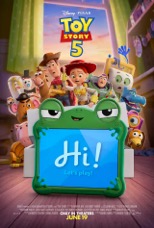
Having sufficiently bashed bad parents, let’s focus on the film’s true villain, the frog-themed computer tablet for kids called Lilypad (Greta Lee). Bonnie’s parents cave and buy her the popular device since all her friends have one. Bonnie becomes instantly addicted to Lily, spending hours a day playing games and conversing with her friends—selected by Lily, of course. Bonnie’s behavior and engagement with her family also radically changes…for the worse. She gets cranky when she has to wait for Lily to recharge and plays on Lily all the way up to bedtime. Bonnie becomes far more sedentary when she plays with Lily. Even worse, her vibrant personality is subdued to the point where she’s practically a zombie.
From these scenes, it’s easy to see how constant exposure to tech can negatively affect social skills and the ability to read social cues, while also numbing the pleasure centers in the brain. Many mental health issues in young people are either made by, or made worse by, the excessive use of tech. And the trend line continues to climb.
So, what makes Lily so malicious? The device chooses the wrong friends for Bonnie (something Lily admits to doing), but says it will do better in the future. Okay. So that makes up for the bullying and ostracism, right? Also, Lily thwarts Woody’s efforts to locate Jessie (the reason Lily can’t refuse Buzz’ commands is never explained—one of the movie’s only plot contrivances).
Lily’s most egregious action is hacking into Bonnie’s account and texting her father to pack up all the toys and put them in the garage. Yes, Lily helps the toys find Jessie and helps Bonnie become friends with Blaze (Mykal-Michelle Harris), but do these positive actions make up for its harmful ones? Lily never apologizes for posing as Bonnie, and manipulating Bonnie’s father, in its plot against the toys. Lily’s apparent transformation is unconvincing because we’ve seen its capacity to do evil, without hesitation or compunction, and know it’s more than capable of turning on its users in an instant. Message: beware the mercurial morality of the machine.
After an awkward introduction, Bonnie and Blaze become instant friends. That’s great for these two girls. But what about the scores of isolated kids out there? Is the happy ending, where tech decides to play nice with toys/kids/parents, disingenuous in light of the countless kids in the throes of digital obsession? Is the “tossing back one starfish at a time” approach enough to positively impact our society, or does wholesale change need to occur?
Unfortunately, the film takes the easy way out and doesn’t properly resolve its central question: What can parents do to help their kids put down their devices, go outside and make some friends? Toy Story 5 highlights a success story, but ultimately fails to deliver a plan for how parents can help their kids balance tech and real life.
Devices taking over our society—depicted in one scene as faces all around the neighborhood lit up by the green glow of electronic screens—is reminiscent of the subtle takeover of our planet by pod plants in Invasion of the Body Snatchers (1956). But is there a greater threat than tech looming on the horizon—AI? Will AI always have our best interests at heart? Doubtful. Skynet (The Terminator) could be right around the corner.
Thankfully, not all tech is portrayed as diabolical in the movie. There’s a charming subplot where older tech—devices that serve one specific function, like a pre-GPS roadmap device, or a handheld potty-training assistant for kids (which spews non-stop toilet humor)—comes to Jessie’s aid. Just as Jessie has been abandoned by Bonnie, the old devices have been relegated to junk drawers by their owners. In a twist of poetic justice, Jessie and the outmoded devices, team up to find Bonnie.
I anticipated a digital v analog showdown like the one in the reboot of Battlestar Galactica (2004), but, sadly, no such conflict occurred. It would’ve been amazing to see the older tech working together to outsmart the “smart” devices. Oh well, fodder for Toy Story 6.
Though radically different in theme and tone, this film is a kind of mirror image of Stanton’s WALL-E (2008). While the robot movie is a cautionary tale of a stark future we must work diligently to avoid, Toy Story 5 is a reprimand for the harmful societal influences that have been allowed to plague our young people. WALL-E is a deterrent; Toy Story 5 is a corrective.
Aside from its adult messages, there’s plenty to enjoy in this kids’ movie. Though merely there to service the story, the “big moment” for the Buzz army is pretty spectacular. There are some meaningful moments too—I got choked up a few times (it’s been known to happen to grown men while watching a Pixar movie), especially during the wedding scene.
So, will there be a Toy Story 6? If so, I hope it focuses more on the ancillary toys, who are largely superfluous here.
In the end, Toy Story 5 isn’t a great film, but it contains the most important message of any animated movie ever made.
Rating: 3 out of 4
Disclosure Day (PG-13)
26/07/26 22:57 Filed in: 2026
Starring: Emily Blunt
June 2026
Warning! This is NOT a movie review. This is a critique of the film. Intended to initiate a dialogue, the following analysis explores various aspects of the film and may contain spoilers. For concerns over objectionable content, please first refer to one of the many parental movie guide websites. Ratings are based on a four star system. Happy reading!
God gave us two ears and one mouth so we can listen twice as much as we speak. You’ve probably heard that aphorism. Sadly, our ability to listen to each other has been significantly impaired in recent decades, especially when the conversation turns to politics or religion.
The timeliness of director Steven Spielberg’s new thrill-fest, Disclosure Day, boarders on the preternatural. There are several hints in the movie that the world is on the brink of global upheaval. With the Russia/Ukraine, Israel/Hamas and U.S./Iran conflicts raging in real life, many believe we’re already in World War III—even if it hasn’t been officially declared as such. Coincidental parallel? Or art imitating life?
Also, the movie comes just weeks after the government declassified files/videos involving what are believed to be extraterrestrial (E.T.) phenomena. Again, is this serendipitous timing or governmental grooming, pre-conditioning people for an earth-shattering alien reveal? There’s plenty of fodder here for conspiracy enthusiasts or the average person who distrusts the powerful individuals that control our nation and the world.
Regardless of whether external agencies influenced this movie’s subject matter or release date, its premise shouldn’t be underestimated: What would you do if you saw incontrovertible proof that aliens are living among us? Would you run to your nearest superstore and hoard supplies? Would you hunker down and hope to ride it out? Would you lose your faith? Or, like Margaret Fairchild (Emily Blunt) does in the movie, would you just roll with it?
The script, written by Spielberg and David Koepp (Jurassic Park), doesn’t waste time dwelling on how humans would respond to the announcement that non-human biologics are on our planet. Instead, they distill these various reactions into a simple binary, represented by Colin Firth’s Noah Scanlon and Colman Domingo’s Hugo Wakefield. Noah wants to conceal the truth at all costs for fear of what people will do to each other. Hugo believes that people deserve to know the truth, regardless of the consequences.
Of course, this reveal/conceal dichotomy represents the diversity of arguments people in positions of power have made for decades (long before Project Blue Book) to either trust people with the truth or keep them in the dark, so as not to create a mass panic. But in the story, this complex dyad is reduced to situational ethics, hypotheticals with no real-world repercussions since Disclosure is a thriller/sci-fi movie.
The film acknowledges the corruption that pervades the halls of power around the world and how an enterprising individual can topple their house of cards by releasing the truth; whether via TV news coverage (a bit passé in the new media landscape—more on this later) in this movie, or a newspaper article in Spielberg’s The Post (2017), which this film echoes in many ways.
Governments conspiring with the military or other private science/tech firms to conceal or explain away the existence of E.T. life is nothing new (Close Encounters of the Third Kind, 1977) in cinema. But here, Spielberg reverses the conspiracy polarity from government concealment (textual—inside the world of the movie) to government propaganda (extra-textual—in the real world). To put it a different way, in past decades, audiences viewed Spielberg’s alien movies as proof of the government’s complicity in covering up the existence of E.T.s. With Disclosure, today’s savvier spectators sense they’re being manipulated, conditioned for an impending eponymous event.
The director’s conspicuous backlog of films featuring aliens, coupled with the recent declassification of some UFO—or UAP (insert vomit emoji)—files by the U.S. government, makes one wonder if this movie was produced and released as part of a government psyop? Was it all pre-arranged, priming us to accept the reality of aliens? Is Spielberg himself an alien? If so, what’s he trying to tell us?
While we’re asking questions, is Disclosure intended to trigger certain behaviors in the audience? For instance, who benefits from the universal acceptance of aliens? Or conversely, who benefits from the widespread fear of aliens? It’s obvious who profits if the movie does well at the box office.
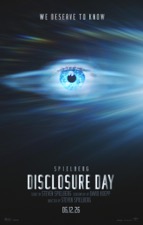
Several scenes offer fascinating insights into the human psyche, allowing us to wrestle with the extraordinary, reality-altering revelations in the movie. During one pivotal scene, a cardinal flies through a window into Margaret’s apartment. A mental connection is made between woman and bird (an alien in disguise). Soon after the encounter, Margaret starts speaking in foreign languages without realizing it. Then, during a live weather report, she speaks in an alien dialect—a series of clicks and pops. All who hear are amazed, confused or frightened. Her boyfriend questions her sanity. She gets impressions of where certain people are located or which direction they’re traveling. Margaret’s greatest superpower is her ability to look into someone’s eyes and immediately know their deepest desires or secrets. Based on what she reads in their minds, Margaret releases people from guilt, gives helpful advice and allows people to see long-lost loved ones. Margaret’s telepathic gift is similar to Sybok’s ability to free people from their pain in Star Trek V: The Final Frontier (1989).
Another interesting subplot involves Jane Blankenship (Eve Hewson), who hides out at a Catholic nunnery to avoid Scanlon’s agents. A former novitiate who walked away from the church, Jane asks Sister Maura (Elizabeth Marvel) if she would lose her faith if it was proven E.T. life existed. The nun says no, she doesn’t believe we’re alone in the universe and that it would be a tremendous waste if God made all of it just for humans. The movie unequivocally affirms that religious people wouldn’t walk away from their faith, and, what’s more, would be even more convinced of the existence of God.
It’s unknown whether real-life religious adherents would have a similar reaction to Sister Maura’s (the events in the movie are fictional, after all), but it’s an interesting point to ponder. It’s also curious that Spielberg, a Jew, chose Catholicism to represent religion in the film; to the exclusion of all other beliefs. Regardless, it’s refreshing to see religion treated so thoughtfully and respectfully in a major Hollywood movie.
Despite its many thrilling and thoughtful moments, the story is filled with plot holes and character decisions that defy credulity. It’s ironic that the strong suit of Spielberg’s thrillers, namely action sequences, are the weak link in this film. Many of the movie’s action beats are ill-conceived, like when Daniel Kellner (Josh O’Connor) steals a car and crashes through a fence, into a tree, into other cars and into the living room of a log cabin to rescue Jane. Then he tears off with a motorcade of sleek vehicles on his tail; the car is riddled with bullets from the pursuing agents.
Later, after sending the car over a cliff to fool Scanlon’s agents, Daniel and Jane head into the woods with the men in black standing just on the other side of a boulder. Wouldn’t the agents have spotted Daniel and Jane or, at the very least, heard their movements as they traipsed through the woods? Why didn’t the deer/alien create a diversion on the other side of the road to lead the agents away from Daniel and Jane? That, at least, would’ve been more realistic.
Though Disclosure is a mashup of Close Encounters, E.T. the Extra-Terrestrial (1982), and The War of the Worlds (1953), it’s “man on the run” plot most closely resembles Minority Report (2002), a darkly futurist film that far surpasses this year’s model. The whole “diving” into other people’s minds recalls the “Pre-Cogs” from Minority Report. In this movie, characters are able to create a mind link via a gray, metallic alien device.
Spielberg and Koepp use this alien Swiss Army gadget to produce all manner of Force-like effects, but it becomes a convenient crutch for the story. Though the device doesn’t have a name, its applications are manifold—just don’t squeeze it, for heaven’s sake. The fact that its abilities, and limitations, are never clearly defined, relegates this nifty artifact to the ranks of other shameless movie gimmicks.
It’s curious that Spielberg/Koepp didn’t turn these alien devices into MacGuffins. With the powers they possess, wouldn’t everyone want one? Indeed, wouldn’t most people kill to obtain one? The magical properties inherent in these devices are completely taken for granted in the movie, which is a head-scratching nitpick.
While Spielberg deserves his fair share of criticism for the story’s shortcomings, his directing is sure-handed and, on occasion, magical. The lively TV studio scenes and the flashback sequence, where Daniel and Margaret learn vital clues about missing moments from their childhoods, is equal parts frightening and beautiful. Spielberg is no stranger to action sequences set on trains, and the one here is appropriately pulse-pounding, shot with visual verve and nail-biting near misses.
The performances in Disclosure are terrific, especially Blunt and Domingo. Firth is reliably pitch-perfect as villain Scanlon. Wyatt Russell (son of Kurt Russell), is effective as Margaret’s fair-weather boyfriend, Jackson. Marvel lives up to her name as the wise nun (Yoda/Mr. Miyagi archetype). Due to his unconvincing acting and his character’s many dunderheaded decisions, O’Connell is the weak link in the cast—ironic since he plays the main character. Despite this miss, kudos goes to Spielberg (and his casting director) for assembling a fresh slate of actors he’s never worked with before.
Someone Spielberg is extremely familiar with is composer John Williams. Disclosure marks their 30th collaboration together. Disclosure isn’t Williams’ most memorable score, but it’s one of his finest at perfectly matching the emotions of the movie. The score is beautifully understated and only grows in intensity when absolutely necessary. Interestingly, one of the main themes of this movie (heard prominently in “listen…” on the soundtrack) has strikingly similar notes, sans syncopation and fortissimo orchestration, as the “Anakin Vs. Obi-Wan” track on the Star Wars: Episode III – Revenge Of The Sith soundtrack.
Williams reportedly toiled on the score for six months and, astoundingly, composed over two hours of music for Disclosure. At age 94, will this be Williams’ final score? I sincerely hope not, but if so, the music for Disclosure highlights his virtuosity and versatility—it contains none of the bombast or rousing fanfares that marked much of his earlier work. Either way, it’s a thrill to experience another masterwork from the maestro, especially after a non-disclosed health issue sidelined him a couple years ago.
While the accompaniment certainly does its job in establishing the overall mood, what’s the real heart of the movie? Some will say the key sequence is when Daniel and Margaret use the device to learn answers about their mysterious pasts. Hard to argue, but for my money, the movie’s most meaningful moment is the subtly stated reason for why humanity is headed for destruction—the “outside observers” living among us believe we’re doomed because we’ve lost our ability to have empathy toward others.
The veracity of this profound indictment comes into sharp focus every time we watch the news. As is the case in the movie’s fictional world, there are conflicts all over the globe today. In the real world, our society is plagued with national, political, ideological, racial, ecological and religious divisions. People kill innocent bystanders on subways and have no idea why. Are we devolving into animals? Are we any less destructive than the aliens we fear?
An outside force stepping into our world and confronting us with our moral deficiencies brings to mind a similar scenario in The Day the Earth Stood Still (1951), where Klaatu (Michael Rennie) warns humanity about the dangers of nuclear power. Obviously the message impacted audiences back then since humans never initiated a nuclear war (thankfully). But Disclosure is a salient reminder of the destructive power held by nations possessing nuclear bombs, which have the capacity to end all life on our planet in a flash.
So, will our collective fear of E.T.s finally bring about global unity? Instead of fighting each other, will we pool our resources to defend Earth from alien invaders, a la the humans in the original The War of the Worlds? Or will our disunity bring about our end, as aliens sit back and watch in bewilderment as we destroy each other, a la the Twilight Zone episode, The Monsters Are Due on Maple Street?
The movie ends with an alien’s admonition for us to “Listen.” This could mean to listen to the alien, but a more likely, and poignant, reading of the scene is that “the gray” is encouraging us to listen to each other, lest our handful of wars expand to embroil the entire globe in bloody conflict. But if we can’t find a way to listen to each other, would we listen to an alien? This brings us back to The Day the Earth Stood Still, which ended well because the aliens had our best interests at heart. But what if the aliens are more like the ones in The War of the Worlds, or in TV series like V, Earth: Final Conflict or Falling Skies? Or, most frighteningly, like the Kanamits in the Twilight Zone episode, To Serve Man.
What if we end up placing our faith in aliens who aren’t trustworthy? What if they have the ability to hypnotize us or cleverly fool us into believing illusions, a la the Talosians in the Star Trek two-part episode, The Menagerie? What if the aliens win us over with lying signs and wonders, a la the Antichrist in the Bible? If someone (or something) seems to have all the answers, humanity would likely follow that individual over a cliff (e.g., Jim Jones in Jonestown, Guyana and David Koresh in Waco, Texas).
The medium for reaching the entire planet with the truth of alien existence would certainly be the internet, right? Why then does Spielberg have the titular event take place at a TV newsroom…in Kansas City of all places (I actually applaud the director for spotlighting a city other than NYC, LA or Chicago)? Yes, there’s palpable synergy in the scenes where producers yell at switchers, who direct camera operators, or when station managers call larger affiliates, who put the “small town” footage on standby. The background business of a TV news production is fascinating, especially when displayed with this degree of urgency. Spielberg has done for TV news in this film what he did for printed news in The Post.
Isn’t Spielberg a few decades behind the times, though? It’s admirable that he chose to spotlight the profession of broadcast journalism, but many people, especially those under 30, don’t watch news on a TV, and may not watch traditional news at all (online commentary shows and podcasts have significantly winnowed the TV news audience).
But let’s suspend our disbelief and say that everyone on Earth would tune into a breaking news story revealing declassified footage that definitively proved the existence of E.T.s. Would people believe it or scoff at it—just another AI fake? Just as Spielberg proves he’s out of step when it comes to the media landscape, he’s also completely unaware of how cynical his audience has become since E.T. (1982), or even Indiana Jones and the Kingdom of the Crystal Skull (2008). Many would see the alien footage, roll their eyes and play the next YouTube video. It’s a sad reflection of who we’ve become, but many would ignore the story and go on living their lives. Not to mention how fractured we’ve become along ideological lines—if the news network showing the alien vids was conservative, the liberal half of the country would tune out the “fake news,” and vice versa. Though this TV newsroom climax would’ve worked decades ago, it doesn’t work in 2026.
The most important line in the movie is when Hugo says people are starved for the truth. People, especially young people, are sick of being lied to. By politicians. By the media. By teachers, religious leaders or even parents. Within the context of the line, Hugo means people are sick of the alien coverup, but in a broader, more keenly felt way, people are starving for real truth, not fake/slanted/reverse/activist/politically-motivated/deceptive truth (otherwise known as mis-, dis-, and mal-information).
In the final analysis, Disclosure is a big swing that asks some big questions, but barely scratches the surface of how humans would react to irrefutable proof (don’t we already have that?) that aliens exist. Far greater than the middling story are the movie’s themes and messages and their implications for the future. Disclosure isn’t a great movie, but it’s insatiably thought-provoking.
The movie may be a slick example of cultivation theory or just a straightforward sci-fi yarn. Either way, viewers are sure to have strong opinions about this movie. Despite its many narrative missteps, Disclosure’s evocative subject matter elevates it to the realm of heady art at best, watercooler entertainment at worst.
So, aside from another alien movie in Spielberg’s œuvre and another hit movie on his filmography, will Disclosure make a lasting impact on its audience or society as a whole? Will the movie be a blip on the radar? Or will it goad governmental and global powers into finally revealing the truth?
Full disclosure?
I have no idea.
Rating: 3 out of 4