October 2026
Coyote vs. Acme (PG)
21/10/26 23:10 Filed in: 2026

Starring: Will Forte
August 2026
Warning! This is NOT a movie review. This is a critique of the film. Intended to initiate a dialogue, the following analysis explores various aspects of the film and may contain spoilers. For concerns over objectionable content, please first refer to one of the many parental movie guide websites. Ratings are based on a four star system. Happy reading!
Coyote vs. Acme is built upon a clever premise: what if Wile E. Coyote, from the Looney Tunes cartoons, got fed up with never being able to catch Road Runner and decided to sue the Acme company since all their patented devices end up breaking down or backfiring? With other animation-infused live action flicks in the Warner Bros. filmography, such as Space Jam (1996), Looney Tunes: Back in Action (2003) and Space Jam: A New Legacy (2021), why not give this idea a whirl, right?
Unfortunately, the story, based on a New Yorker article written by Ian Frazier, starts falling flat almost immediately due to two important facts about the characters: 1. All the animated characters, consistent with the way they act in the Looney Tunes cartoons (Tweety is the one exception, but there are mitigating circumstances for the little bird’s uncharacteristic behavior) are portrayed as shallow, one-dimensional characters, and 2. The humans are all stereotypes—small-time, risk-averse lawyer who finally lands a big case, Kevin Avery (Will Forte); overeager intern, Paige Avery (Lana Condor); and bullying prosecutor, Buddy Crane (John Cena). Sidebar: is Buddy related to lawyer Denny Crane (William Shatner) in Boston Legal? Either way…shameless rip-off.
The acting here is over-the-top and relentlessly silly. It’s ironic that the animated characters are presented as real, while the human characters are depicted as caricatures.
Much of the movie centers around the titular lawsuit. As such, a significant portion of the story takes place inside a courtroom, which is, arguably, one of the most boring locations ever for a kids’ movie. Some jokes and random antics help move these scenes along, but there are long stretches of the film where characters are sitting in a courtroom with nothing major happening. There are also plenty of scenes at Kevin’s law firm; a small, dingy set, that looks similar to the law office in TVs The Rainmaker—P.J. Byrne from that show plays Bill Pelicanos, Crane’s assistant, here. These scenes aren’t lively enough for kids and aren’t compelling enough for parents…they bog down the story with mundane situations and dialog.
Then, when writers Samy Burch, James Gunn, and Jeremy Slater actually have a good idea, they squander it with gimmicks and cliches. Case in point, there’s a thrilling scene where a dark tunnel opens inside the wall of a building. Characters enter the cartoon environment, a creepy cavern that eventually reveals a clue. But, before anything interesting can happen, the characters are forced to flee the tunnel by a runaway train.
There’s so much more that could’ve been done with the animated portal that opens inside our world; like introducing an important side character, having one of the humans get lost or kidnapped, or causing the humans to stumble through a black hole, which deposits them on Mars, where they have an encounter with Marvin, who doesn’t appear in the film. Point is, the creative options were endless, yet the writers used the alternate world as a mere contrivance—the fact that the clue could’ve been revealed in numerous ways in the real world is proof positive of lazy scripting by Burch, Gunn & Slater (yep, sounds like a law firm).
One of the movie’s main themes is persistence—a quality exemplified by Coyote, who repeatedly fails and yet gets up every day and keeps trying to reach his goal. Even though Coyote’s ongoing attempts at capturing Road Runner is literally the definition of insanity, it’s an inspiring example of tenacity we humans would do well to emulate when pursuing our goals and dreams.
There’s a touching scene where Road Runner wants to know when Coyote will return to the desert. This foregrounds an unexpected friendship that’s developed between pursuer and pursued. Road Runner is the object of Coyote’s obsession (a distant echo of the eponymous white whale and Ahab in Moby-Dick) and Coyote is Road Runner’s entertainment and fitness partner.
There’s another unlikely friendship in the film. Kevin is the only person who takes Coyote seriously. He keeps fighting for the aggrieved toon despite long odds, reputational risk, and potential financial ruin. These scenes drive home another of the story’s themes—the importance of friendship—while providing some genuinely heart-warming moments.
In the end, this inoffensive family film is uber-cute and contains a few good laughs, but fails to achieve the same level of fun and synergy exhibited in Space Jam. Still, the movie’s target audience will surely enjoy the movie, regardless of my quibbles and objections.
At movie’s end, Coyote returns to the desert and his eternal pursuit of Road Runner. In our chaotic world, it’s nice to know that some things never change.
Beep, beep!
Rating: 2 out of 4
The End of Oak Street (PG-13)
18/10/26 21:38 Filed in: 2026
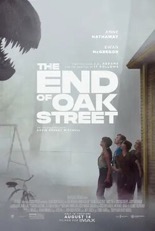
Starring: Anne Hathaway
August 2026
Warning! This is NOT a movie review. This is a critique of the film. Intended to initiate a dialogue, the following analysis explores various aspects of the film and may contain spoilers. For concerns over objectionable content, please first refer to one of the many parental movie guide websites. Ratings are based on a four star system. Happy reading!
The End of Oak Street, the new film from director David Robert Mitchell (It Follows), is an ambitious mashup of numerous franchise movies and TV series. It’s a well-balanced genre stew, combining ingredients from Jurassic Park (dinosaurs), Stranger Things (80s setting and group of boys on bikes), Under the Dome (time bubble that displaces/separates a neighborhood/town), Jumanji (large animals rampaging through suburbia), TVs Land of the Lost (a family transported to a prehistoric era), and too many other sci-fi/fantasy stories to mention here. Though the movie’s amalgamation of story elements creates a familiar formula, it’s also a winning one.
Greg Platt (Ewan McGregor) and Denise Platt (Anne Hathaway) are in a failing marriage—Greg is too laid-back and Denise is too uptight. Neither is open and honest with the other: Greg hides the fact that he’s been fired from his job and Denise is concealing a novel she writes in the basement late at night. The kids, Audrey Platt (Maisy Stella) and Brian Platt (Christian Convery) are standard issue teens with the requisite tendency toward bad decisions, which helps ratchet up the drama—the whole “kids in peril” trope.
The story, by Mitchell, wisely establishes its characters and setting before launching into the thriller elements. This allows the audience to identify with the family’s confusion and shock when they first encounter prehistoric flora and fauna. But the “terrible lizards” in the movie are more like “terrible birds.” They’re scary, but they aren’t frightening—not like the raptors or T-Rex in Jurassic Park (1993).
Unfortunately, we have the aforementioned Steven Spielberg dino-palooza to blame for the supposedly accurate version of dinosaurs (were the world’s leading dinosaur experts alive 65 million years ago to confirm the appearance of large creatures we only have skeletons of today?), which Dr. Alan Grant (RIP, Sam Neill) says resemble present-day birds more than lizards. Regardless of their veracity, the dinosaurs in this movie (e.g., raptors with plumes of feathers streaming out the back of their skull) just don’t strike fear into the viewer like Spielberg’s do.
Other than its high concept story—a family displaced in time—much of the movie is insufferably silly. In Alien (1979), Ripley (Sigourney Weaver) risks being eaten by a xenomorph to save her cat. Here, Brian runs off into the night to save his dog, Starbuck, even though he knows there are large, carnivorous creatures lurking about. Then, Audrey runs after him. I guess if the kids stayed home we’d have no story, but this is a ridiculous plot contrivance.
Side note: some have commented on how shameless it is to name the family dog after the ubiquitous coffee company. I think their opinion is erroneous. My evidence is the Battlestar Galactica (1978) poster hanging on the wall in Brian’s bedroom. Of course, maybe I’m wrong too, and the dog is named after the character in Moby-Dick.
Mitchell’s direction is taut and the action sequences are considerably gorier than those in the Jurassic films. As a horror film craftsman, Mitchell effectively utilizes offscreen sounds, rustling trees, moving shadows, and glimpses of dinosaurs to ratchet up the tension. One of the movie’s creepiest moments involves a large worm-snake, which almost seems to be smiling…until it opens its mouth and reveals rows of razor-sharp teeth. The entire sequence, where it silently slithers through the house, is peek-through-the-fingers terrifying.
Earlier, I mentioned the movie’s winning formula, which includes deft directing, solid acting, a unique take on the well-worn dino thriller form, and a rather elegant and satisfying resolution. But will this edge-of-your-seat popcorn movie do well enough to warrant a sequel? If so, I have the perfect name: A Nightmare on Oak Street.
Rating: 2 ½ out of 4